Here’s What You Should Actually Look Out For When Antiquing (We Asked A Curator)
in with the old
By Natalie McGowan | 17th July 2026You ever walked into one of those homes that is full of character? More often than not, spaces like this come with a collection of pieces gathered over years of collecting and arranging antique heirlooms. There’s a distinct feeling to spaces like these, one which Bronte Taton, the founder of gallery design studio Cleo Collects, has become very familiar with as a bona fide master in antique sourcing.
Bronte spent her high school years in Paris studying fine arts, attending galleries, and developing a curatorial eye in one of the most design-forward cities in the world. Flash forward to today, and that foundation has become Cleo Collects: a gallery and design studio based in Western Australia specialising in contemporary art, Art Deco, Brutalist and Cubist antiques, and rare European design.
We caught up with Bronte to get her expert take on all things vintage and antique furniture – from what to look out for, how to tell if you’re being ripped off, to how to style vintage pieces in your modern home.
For someone who is new to buying vintage or is intimidated by the whole thing, where would you tell them to begin? How do you develop an eye for it?
Reading through design magazines, visiting design weeks, going travelling… those are the points that really inspire me. Then doing a little bit more research online about prominent designers from specific eras, reading coffee table books – I mean, there are so many places that you can start. If you were to travel and go to Paris, I would say go to the Clignancourt markets over there and just walk through. You don’t have to buy anything. You can just be inspired by what’s there. Even when I approach design, I always think that if you love a piece and your heart really sings when you see it, you’ll always find a spot for it. So I’m more about designing around pieces rather than finding artworks and furniture to fit a particular brief. I just think all of these eras, whether it’s Brutalism or Art Deco, they all work together quite nicely. And it tells a story to have a really layered interior that mixes the contemporary with the old.
And when it comes to going vintage shopping or antique shopping, how can buyers tell the difference between something that is authentic and something that was reproduced?
The devil’s in the detail. It’s all looking at the wear of the piece as well. For example, Audoux-Minet is quite a well-known designer from the 50s and 60s in France, using a lot of rope, and you get a lot of reproductions of that. But you can tell the old from the new because there’ll be slight fraying and a discolouration to the old ones. There’s more patina. But also, you want to be dealing with dealers that specialise in those designers as well, and getting a certificate of authenticity when you can, having an understanding of provenance. So, do a bit of research into the designer before you procure the piece so that you have an understanding of what designs are iconic to that designer, what materials are iconic to that designer, and maybe quiz the dealer on when it was made and where it was purchased from. But it doesn’t have to be a designer piece for it to speak to you. And as you go on, you learn to recognise quite quickly whether something is authentic or it’s been reproduced recently.
Is there a way for you to determine whether a price is fair or if you’re being ripped off?
Again, it’s all down to research, when you have an understanding of the market and what its value is. Obviously, its value in Europe is going to be very different from its value in Australia because we have to add customs and container fees to it. So, it’s more just about being on the ground, emailing around, getting quotes from dealers, and having a look through all of the platforms, like 1stDibs, Proantic, and Selency, to gain an understanding of what the base value is for it. And also knowing that some of these third-party marketplaces put a commission on top of that – often, something like 1stDibs will be 40% above what you would actually want to pay for the piece, so it’s just down to research. The more you do it, the more you develop an idea about what things are worth and how they’re increasing in price over time. We’ve definitely seen increases over the past five years that we’ve been doing this on Murano pieces, for example, and scarcity as well. Vintage is just having a massive moment right now. I think people are leaning towards buying pieces that are timeless and not mass-produced, and have been handcrafted. So, naturally, scarcity leads to higher pricing.
Which materials or fabrics age the best? How do you care for these pieces to ensure that they have longevity?
I think it’s really down to the origins and the fact that a lot of these pieces are handcrafted and hand-carved. It’s not made with machinery. It’s not made with cheap product. Pieces from the Art Deco period, for example, that period in history was known for its opulence, using really expensive French oaks that are going to just last forever. Even some of the tapestries, when you use natural materials like silk and wool, some of those that we’ve had come through are around 400 years old. It’s being familiar with the materials that are going to last the longest, but also what era it comes from, and the processes that have been involved in making that piece. And then, in terms of the longevity of it, these pieces, they tell a story. They are imperfect. And I think it’s really important for people to understand that. We have some clients who expect a perfect piece, and that’s just not telling the story of the piece at all. There’s going to be marks, and that adds to it as well. It’s working out what part of a piece should be restored versus what should just be kept to define its age and its story. We do definitely do some restorations to pieces, but it’s always in keeping with the original products that were used, or just patching up the small little crack or whatever it is. But we try not to touch it too much because we want to keep the piece as original as possible.
Are there any pieces, styles, or eras that you think are worth investing in right now?
Murano from the Art Deco period, particularly by Barovier, is always going to be something that goes up in price because there’s limited production of them, and the way that glass ages is really beautiful, too. And then Brutalism from the 50s, 60s, 70s from Belgium and from France is really popular because it’s kind of wabi-sabi and organic in its form, and I think it works really well in modern interiors as well. The known mid-century Art Deco designers from France, like Charles Dudouyt and Guillerme et Chambro, those pieces are becoming collectibles, and we’re seeing a lot of that in Australia. So, I would say the Art Deco period and Brutalist, and the Murano are good investment pieces and can really bring a lot of character to a space.
What drew you to antiques and vintage in the first place?
My parents are French; they’re from Montmartre in Paris, so when I was 13, we relocated back to Paris, and I studied fine arts there in high school. And we did a lot of visits to museums and galleries, and that was what first sparked my interest in the arts. Through my 20s, I was wanting to reconnect with my French culture, because I’d moved back to Australia at that point. I just always loved going back to Paris and seeing my extended family and going through the markets and the antique fairs, so I decided to invest in a few pieces. I went and did a little buying trip and met dealers. I launched the Instagram and started with a really small budget and a small kind of collection, then it’s just grown and developed over time. Now, we get a couple of containers a year, and we have a design studio, and we’ve got interior architects and everything as well now. That’s how it grew – wanting to link the two cultures together and make Paris a tax offset, basically.
Looking back on all of the incredible pieces that you’ve sourced since you started Cleo Collects, what do you look back on as the best find, and what was the story behind it?
Oh, that’s really tricky. There are a few different things that come to mind. A lot of the Charles Dudouyt sideboards are really beautiful, and we deal with an antique dealer who’s in his 90s, and he specialises in this designer. Working alongside him and understanding the knowledge that he has is really special. And then I guess having studied art, I’m really drawn to paintings, particularly Cubism. We’ve had some pretty incredible Cubist pieces come through and some have been artists who have shown in the George Pompidou over in Paris or the Modern Museum of Art in London. It’s really amazing when we get some of these artists who come through that have this significant position in the art world. And even if they’re just passing through our hands for a moment, it’s amazing to be part of that process. And the tapestries are amazing. They’ve all been hanging in castles for hundreds of years.
What about the oldest piece that you’ve ever sourced?
I think it would be the tapestries because they date back to the 1600s.
What does a typical day sourcing vintage and antiques look like for you?
If I’m on the ground, then it’s very different. I’m meeting the dealers in person, I’m wandering through and waiting for something to catch my eye, or I’m going to a particular design fair. But when I’m in Australia, I have my auntie who works for me just outside of Paris, so she’s on the ground and she’ll go and have a look at pieces in person for me. But now, I have developed a really good relationship with dealers that specialise in certain designers, so I know that the product that they’re going to give me is of really good quality. It’s a lot of late-night phone calls, with the time difference in France. It’s not as glamorous as people think. It’s a lot of freight logistics. We attend auctions online, too. We will do them in person if we’re on the ground, but a lot of the time, it’s like a midnight auction that’s going on in Paris, and we’re just trying to lock down a few pieces from that.
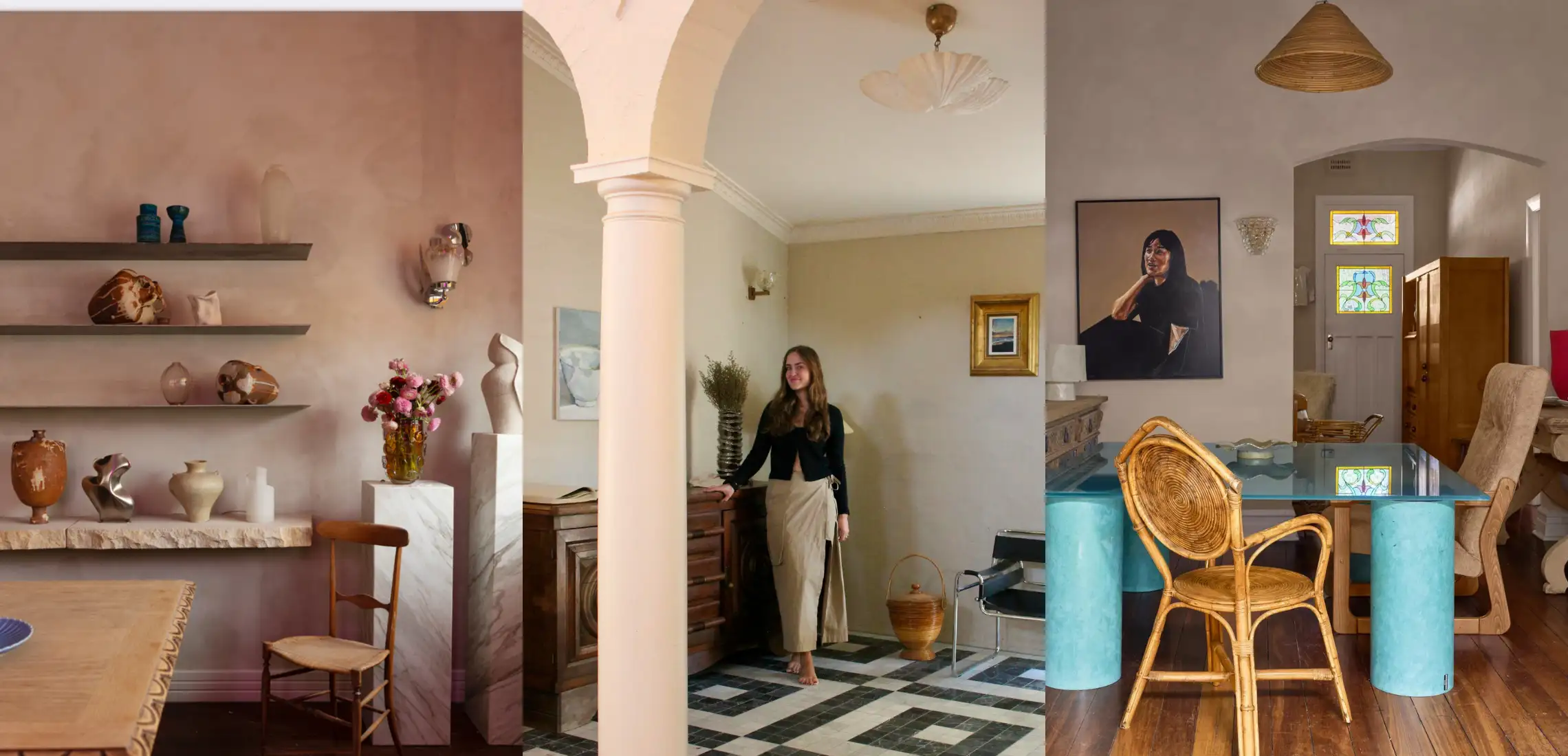
Do you have any advice about the best way to incorporate antiques with modern touches?
Invest in a key piece like a sideboard, which is such a sculptural piece to add to a room, and then you can layer that with contemporary designers – I love to see that kind of juxtaposition. Don’t be afraid to mix elements and timbers. I think a lot of people think the timber must match, but I think some of the best interiors have a mix of everything. Even artworks are a really easy way to bring character and soul into a place. You can often find some pretty decently priced works online. I always gravitate towards quite textural pieces, Cubism, or figurative works – something interesting that tells a bit of a story. It’s not about overwhelming a space with antiques and vintage. I think if you pick the right pieces, they can sit alone quite nicely and be placed in any interior, really.
Imagery: @cleo.collects