Meet Cover Artist Shaun Daniel Allen, Who’s Inspiring Us To Make Something Of Our Own
more than face value
By Kiri Johnston | 14th August 2026In a world where everyone seems to be chasing the next big thing, meeting Shaun Daniel Allen, our cover artist for Issue 04, felt refreshing. He arrived at China Heights in Surry Hills on a winter morning with a calm, quiet presence. As he moved through our cover shoot and we began talking, more of the person behind the work emerged.
Shaun Daniel Allen, known as Shal, never set out to become an artist. He simply started making things. Today, the Yugambeh-born, Bundjalung man is creating work shaped by Country, memory and the natural world, but spending some time with him, I quickly realised there’s much more than face value.
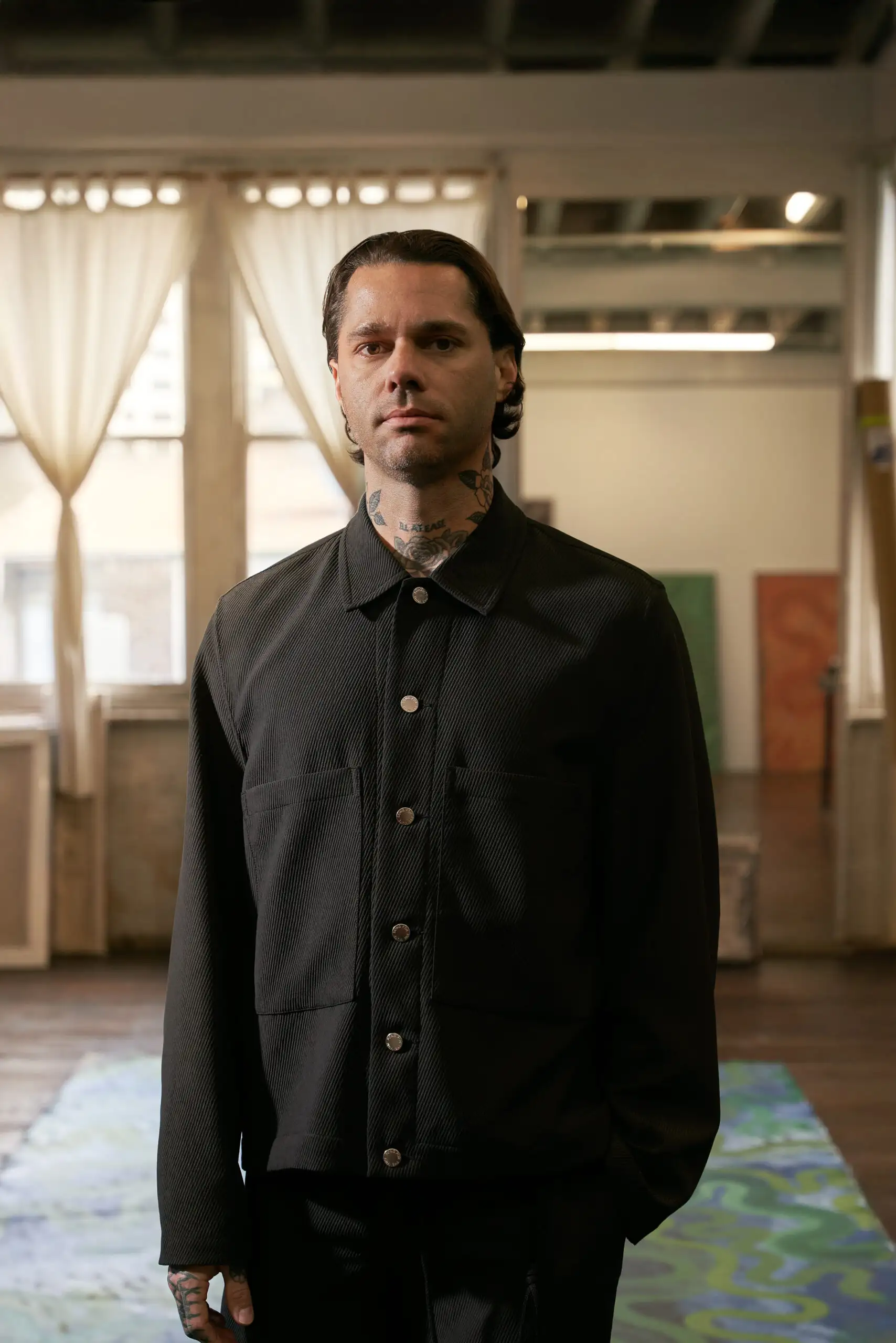
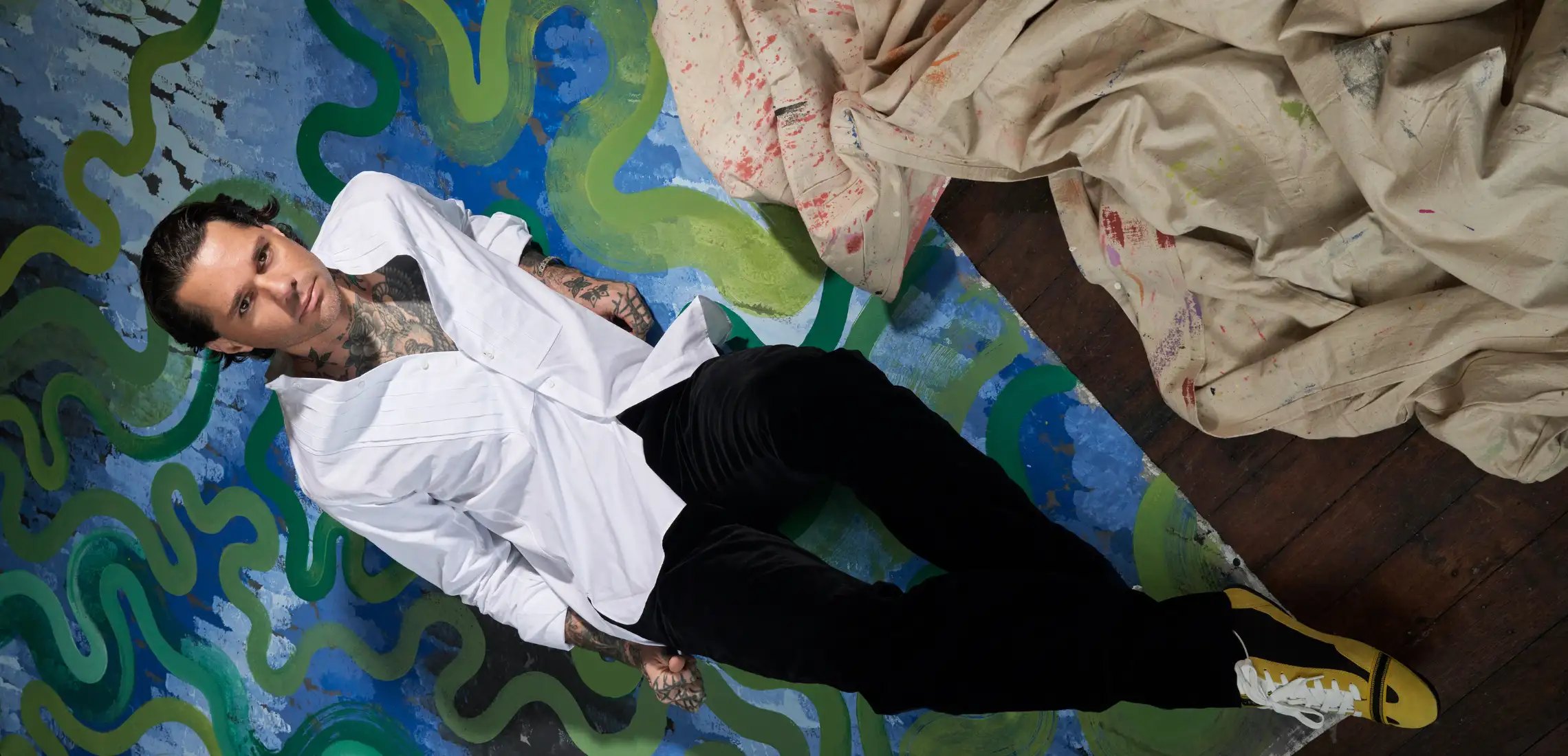
Shal wears SONG FOR THE MUTE Box Jacket $1,095, SONG FOR THE MUTE Unisex Relaxed Lounge Pant POA. Photographed by Shelton Leong.
I’d come across Shal on Instagram a few months earlier and was drawn to his work. Painting, tattooing, music, photography, his creativity seemed to move easily between forms. In person, he is gentle but sure of himself. Humble, without playing himself down. There is no great performance to him, and he doesn’t seem particularly interested in convincing anyone of who he is.
That same attitude carried through the shoot. He was a natural in front of the camera, but when I mentioned it, he simply shrugged. “I don’t paint to have photos taken of myself.”
Making things
For a long time, Shal wouldn’t call himself an artist. “I still think I just revert to a person that’s just making things,” he tells me. Today, his relationship with the word has changed. Being an artist, he says, means “putting the creative part of life first and foremost, and feeling very fortunate to do so.” And he makes things constantly.
I ask if there’s anything he can’t do. “There are plenty of things,” he laughs. He photographs, draws, makes art, and has tattooed for much of his adult life, and these days he continues to experiment with different mediums.
Growing up on Yugambeh Country on the northern Gold Coast, he didn’t consider his family particularly creative. Art, as he understood it then, belonged somewhere else. Looking back, he sees it differently. His mum would scribble in a notepad while talking on the phone. His grandfather was a concreter who made things around the family home and incorporated the Aboriginal flag into his shed. His uncles built cars. Things Shal once dismissed as simply work, he now recognises as forms of creativity. “They kind of were,” he says when we talk about whether these things could be considered their own art practices. It was around him all along.
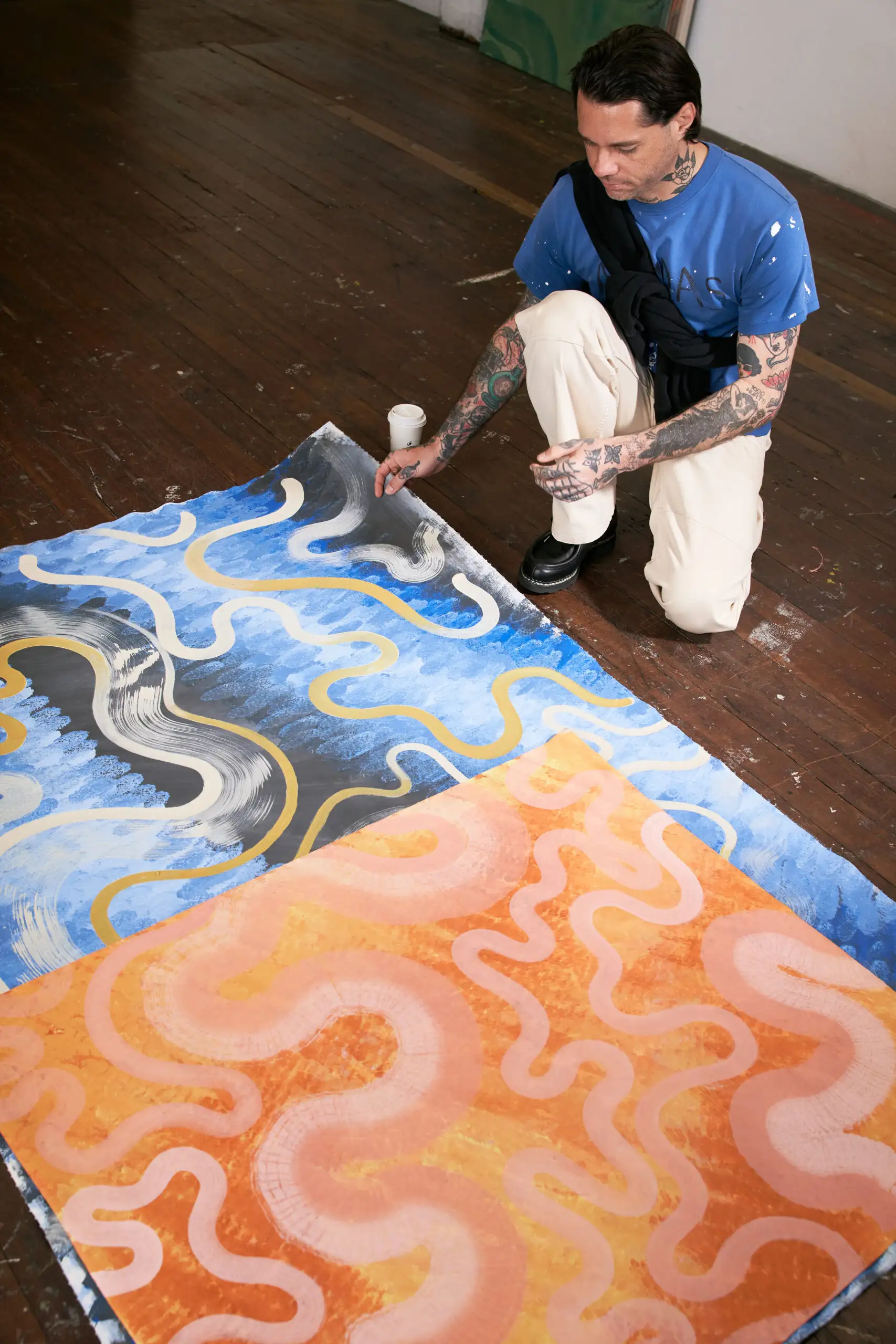
Shal wears Song for the Mute x adidas 007 Tee $150, stylist’s own Gucci hoodie, and Shal’s own Acne Studios pants and Paraboot shoes. Photographed by Shelton Leong.
The creative world Shal eventually found came through music. Surfing introduced him to heavier music, which led him towards the local punk and hardcore scene in the early 2000s. It was small, DIY, and full of people creating because they wanted things to exist. People photographed shows, made zines, printed T-shirts, created album covers, and formed bands, long before social media was around. “The whole creativity thing kind of stems from there because it’s so encouraging,” he says. “You can do anything and everyone will help you.”
That encouragement gave Shal permission to keep trying things, without necessarily knowing what might come of them. At one show, some older guys invited him to watch their band rehearse. When he arrived, they had already written the songs and essentially told him he was going to sing them. “I was like, I don’t want to do that,” he laughs. But he did it anyway, and one thing led to another. Playing in bands led to touring, touring led to documenting, and documenting led to photography. Eventually, that world led him to tattooing.
Tattoos turned art
Living on the Gold Coast, Shal would commute to Brisbane every day to work at tattoo studios in the Valley and West End. He remembers tattooing throughout the day, then going home to draw for the following day’s clients before waking up and doing it all again. “If you’re not obsessed with it, there’s no point in doing it.” For all the creativity tattooing required, Shal didn’t necessarily consider it art. To him, it was a trade.
Painting came later, during a difficult period in his life. Another tattoo artist introduced him to meditative art-making and gave him a simple piece of advice: make something with no beginning or end. Nobody has to see it. It doesn’t need to become anything. It can just be for you.
So Shal began painting. With butcher’s paper spread across his garage, he lost himself in building textures across huge sheets of it. There was no intended outcome and no audience in mind. For perhaps the first time in a long time, making something didn’t need to lead anywhere. “Just for you,” he says. That freedom remains part of what painting gives him today. He admits there are “a lot of cogs turning”, but painting is different. “Painting is 100% the thing that I can switch off and just let it happen.”
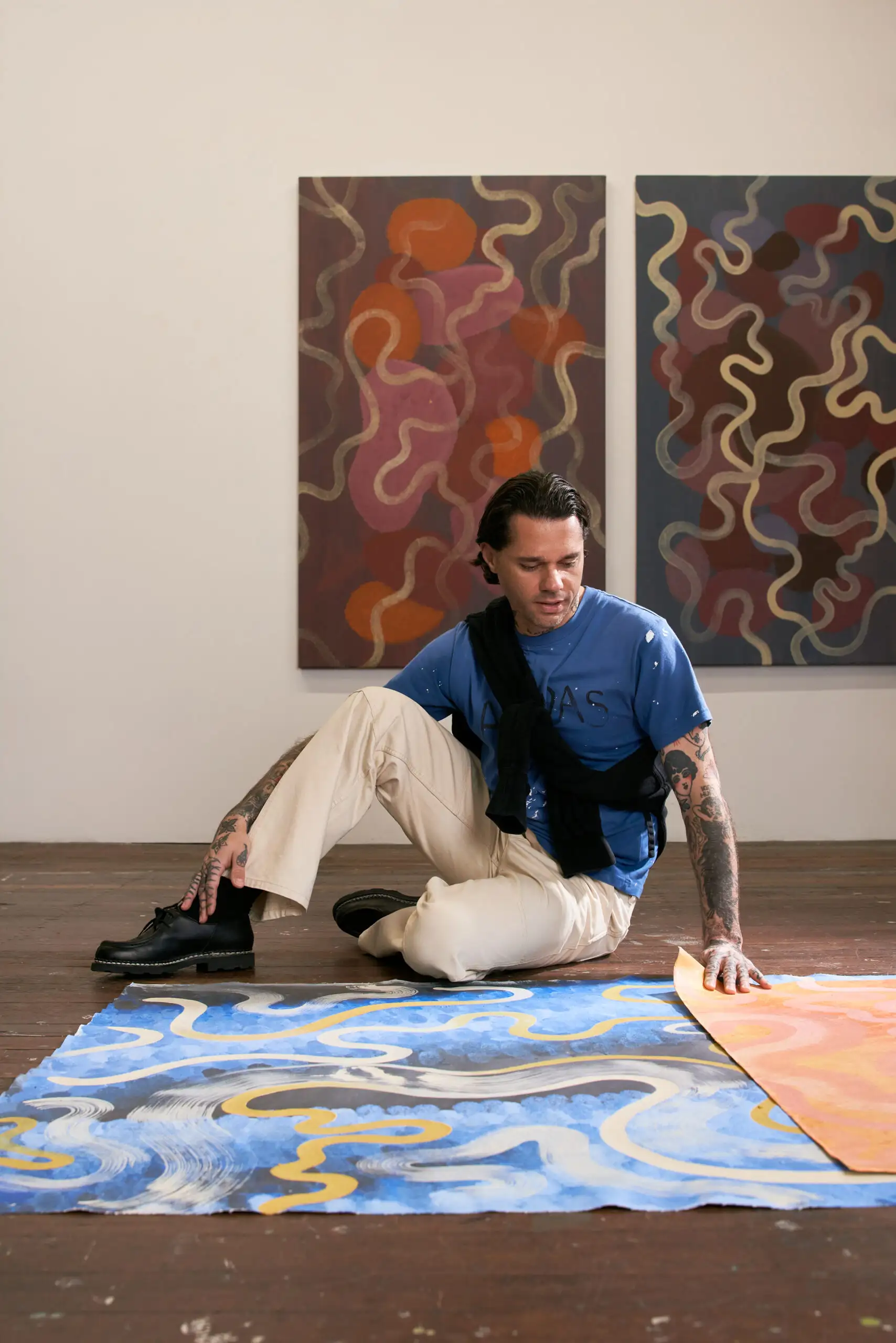
Shal wears Song for the Mute x adidas 007 Tee $150, stylist’s own Gucci hoodie, and Shal’s own Acne Studios pants and Paraboot shoes. Photographed by Shelton Leong.
Connection to Country
Slowly, the textures he was creating started to resemble water. Without consciously setting out to do so, Shal was finding his way back to the waterways he had grown up around.
Water appears everywhere in his story. The Nerang River near his grandmother’s house, the ocean, rock pools, South Straddie, where he surfed the same spot from his teenage years until he moved to Gadigal Land in Sydney.
When I ask what he remembers most about those days, his answer is less about surfing than everything it took to get there. “That everything took time. You had to earn your spot in the line-up.” He remembers dark bike rides along the Spit road and paddling across the Seaway with his friends before sunrise, staying close together while “freaking out about what was behind the trawlers coming in from sea”.
It makes sense, then, that when asked where he feels most like himself, his answer comes easily. “In the water. Always.” Years later, looking out over home from a flight south, Shal saw the shapes he had been creating repeated across Country below. It was then that he realised the connection had been there all along.
That relationship with Country runs much deeper than the forms appearing in his paintings. For Shal, it has also been a process of reconnection. He speaks candidly about growing up at a time when members of his family didn’t necessarily feel they could be loud or proud about being Indigenous. His grandfather had been disconnected from where he came from at a young age, while his mother grew up through the 1970s and ’80s, when drawing attention to your Aboriginality could carry very different consequences.
As Shal has grown older, understanding that history and reconnecting with Country and community has become increasingly important to him.
“You’ve got to know where you’re from to know where you’re going.”
It also informs the way he works. When Shal returns home, he gathers materials from Country with intention and respect, seeking permission before taking a small amount for his practice.
He is conscious of where they come from and clear that he wouldn’t simply take material from Country that isn’t his own. As his practice has grown, so too has his understanding of the responsibility that comes with it. “There’s no ‘l’ in all of that,” he says.
For Shal, knowledge is also something to be shared. Once people hold it, he says, they want to pass it on. “It’s for everyone.” That generosity carries into the way he thinks about making art more broadly. You don’t need to go to art school or call yourself an artist. Nobody ever needs to see what you make. You can simply make something because you want to.
Photography is another part of that practice. Shal shoots every day, documenting friends, landscapes, water, light, and the small things that catch his eye. Growing up, there weren’t many photographs of his family, and as people passed away, he remembers everyone scrambling for images. The same happened with friends he had played in bands with. “We didn’t take enough photos,” he says. Now, he does.
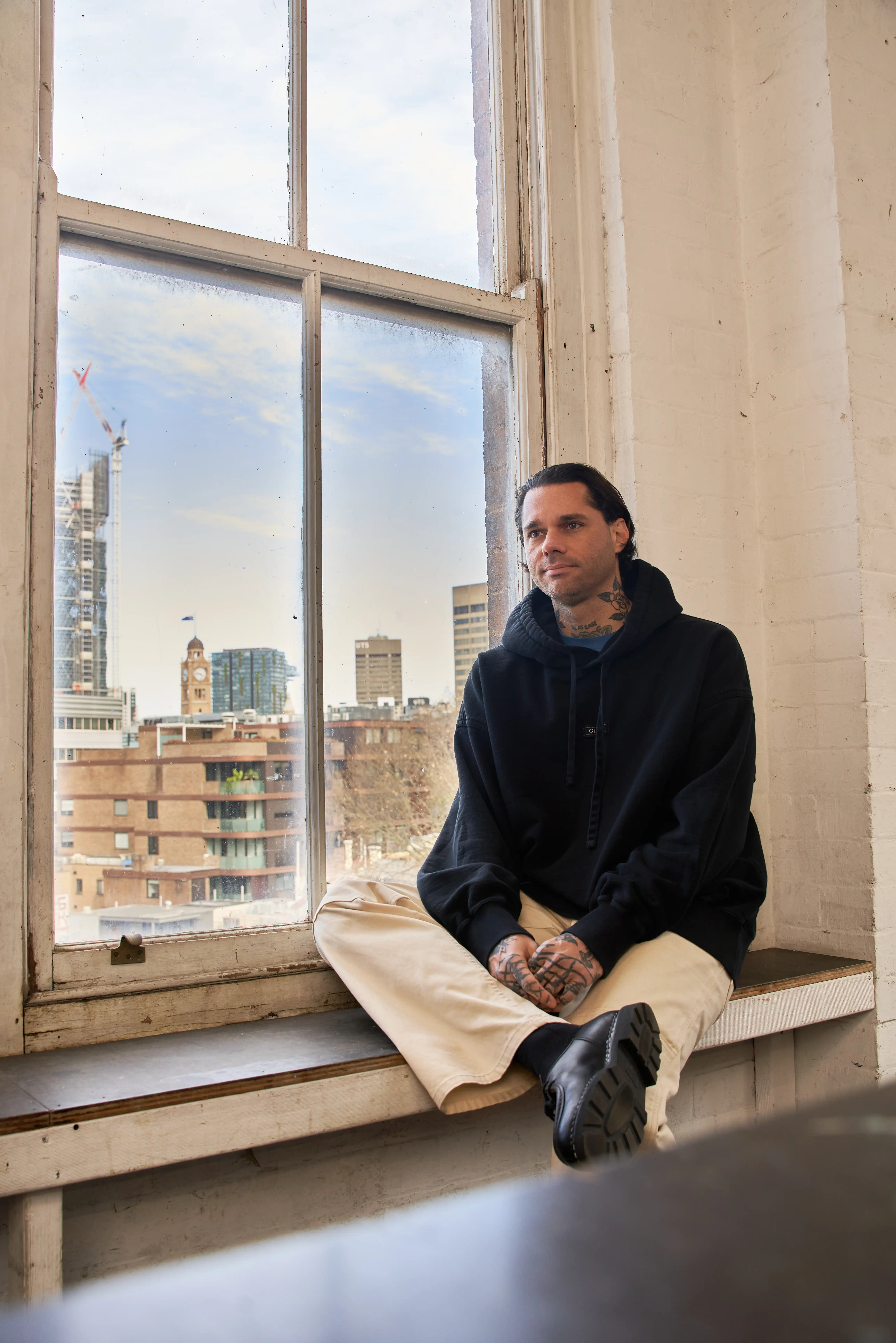
Shal wears Song for the Mute x adidas 007 Tee $150, stylist’s own Gucci hoodie, and Shal’s own Acne Studios pants and Paraboot shoes. Photographed by Shelton Leong.
“Documenting something is still an artistic practice.” Not everything needs to feel important at the moment it is created. Sometimes its meaning arrives later. A photograph becomes a memory, a texture painted across paper becomes water, and what began simply as making things has gradually become a life built around art.
Shal has lived in Sydney for several years now, although that wasn’t necessarily part of a grand plan.
Connections through tattooing and music eventually brought him into the orbit of China Heights founders Nina Treffkorn and Edward Woodley. Artists within the gallery encouraged him to spend time there and develop his practice. At one point, he came through Sydney and was simply told he should stay, so he did. What was supposed to be temporary stretched out as he made work and found himself surrounded by other artists.
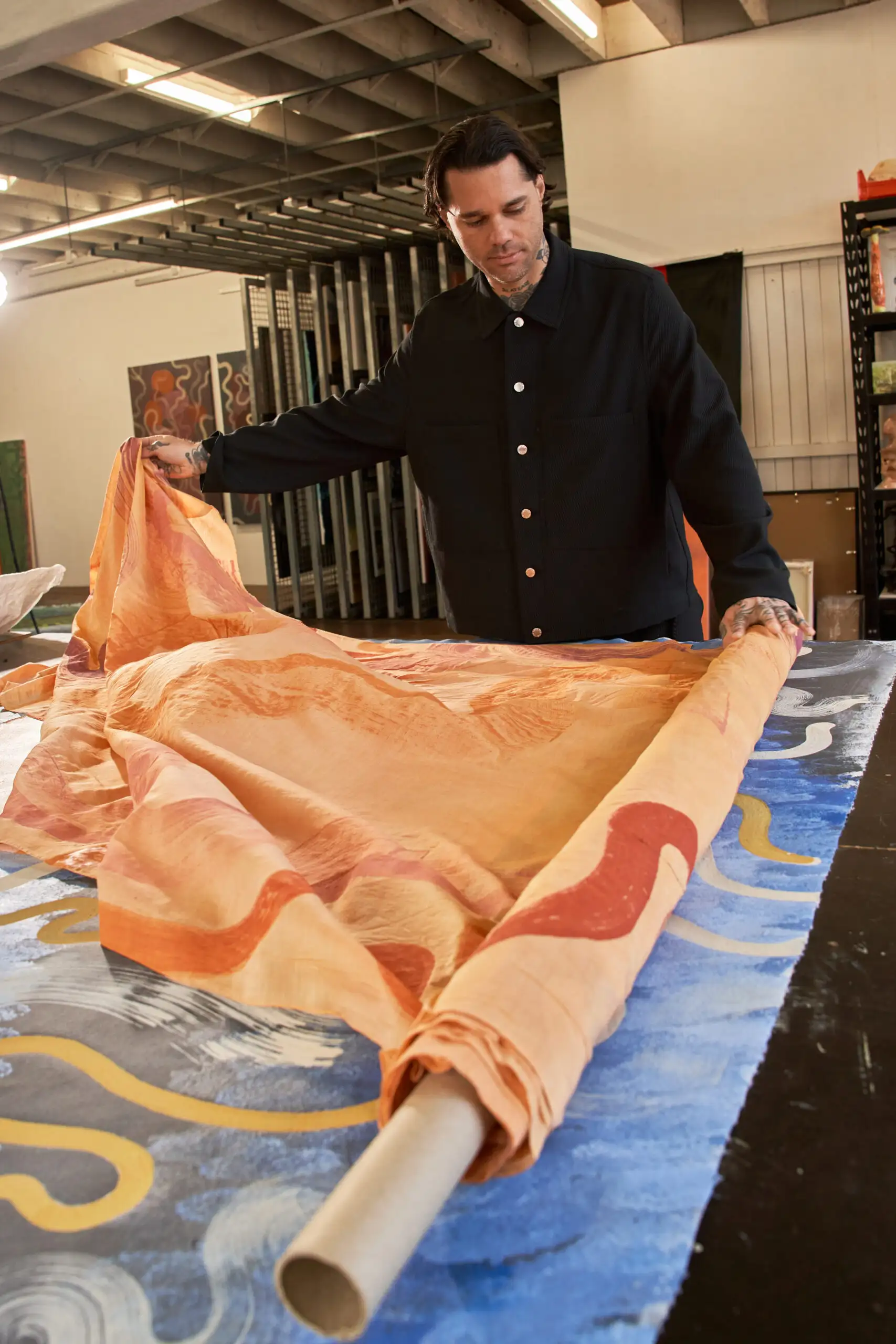
Shal wears SONG FOR THE MUTE Box Jacket $1,095, SONG FOR THE MUTE Unisex Relaxed Lounge Pant POA. Photographed by Shelton Leong.
“I didn’t go to school for art,” he says. “I knew tattooing, but I didn’t know, like, art.” At China Heights, he learnt by being around it. Then, the gallery engaged him to create a work for a commercial commission. For someone who had spent years making things without imagining they could become a career, the exchange was almost difficult to comprehend. “I didn’t think that it was a thing.” His work began selling, his relationship with the gallery evolved, and more opportunities followed. His debut solo exhibition, Balun (River), opened at China Heights in 2021, exploring his connection to Country and self through the forms and textures.
Since then, his work has moved well beyond those beginnings. In 2023, Shal collaborated with friend and fellow artist Otis Hope Carey on Where The River Meets The Ocean, an exhibition at Louis Vuitton Brisbane exploring Country, waterways and the meeting of their respective visual languages. His practice has since encompassed exhibitions, institutional commissions and projects with Hermès, Chopard, Nike and Apple Music, alongside work with the Art Gallery of NSW, Powerhouse and Museum of Contemporary Art.
I ask how it feels to look at where making things has taken him. “Crazy,” he says. “A bit unusual.” Perhaps that reaction makes more sense when you know what came before it. Shal had done almost every job imaginable: trades, labour hire, mowing grass beside a highway at midnight, and even working in a butcher shop while vegan. He assumed that kind of working life would be his forever.
Now, when I ask what he values most about the life he has built, his answer is simple. “Freedom.” Freedom to make, travel, hear people’s stories and work out what comes next. He’s now looking towards Europe, exploring residencies and opportunities to exhibit his work there.
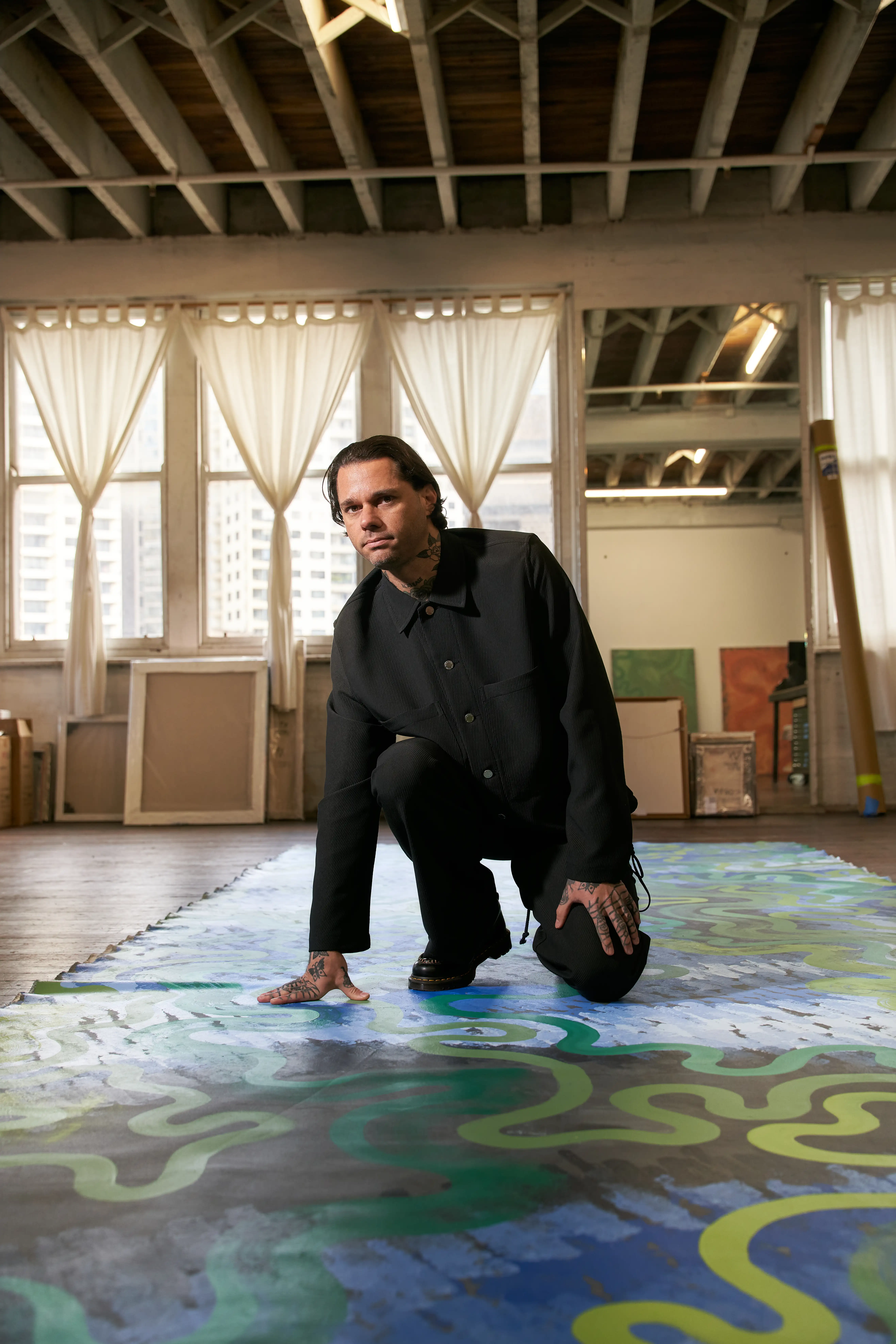
Shal wears SONG FOR THE MUTE Box Jacket $1,095, SONG FOR THE MUTE Unisex Relaxed Lounge Pant POA. Photographed by Shelton Leong.
“You’re never going to perfect the craft,” he says. “Just trying to learn.” That curiosity hasn’t left him. He takes classes with friends who teach art, works alongside other artists to learn different techniques, asks peers to critique his photography, and spends time in other artists’ studios. “I just literally want to learn stuff.”
Despite everything his work has already brought him, Shal is always looking for ways to improve. He tells me he’ll make something he believes is the worst piece in a collection, only for someone else to tell him it’s their favourite. “That’s art, really. Everyone sees something different.”
“Imagine just loving everything you do,” he says. “How’s there a drive to progress in life if you’re like, I’ve already done it?” Shal certainly doesn’t believe he’s done it.
When I ask what he hopes his legacy might eventually be, he doesn’t mention exhibitions, awards or the names he has worked with. He comes back to the encouragement that shaped him. “Hopefully wedge the door open and get other people in there.”
Others did the same for him. People in the hardcore scene gave him permission to make things. A tattooer told him to paint without worrying where it might lead. Nina and Ed gave him somewhere to work and a reason to keep going. Now, he wants to pass that encouragement on. Because to Shal, making isn’t reserved for people who have studied it, mastered it, or earned the right to call themselves artists. “Whatever you’re making is just true to you.”
IN SHAL’S WORDS
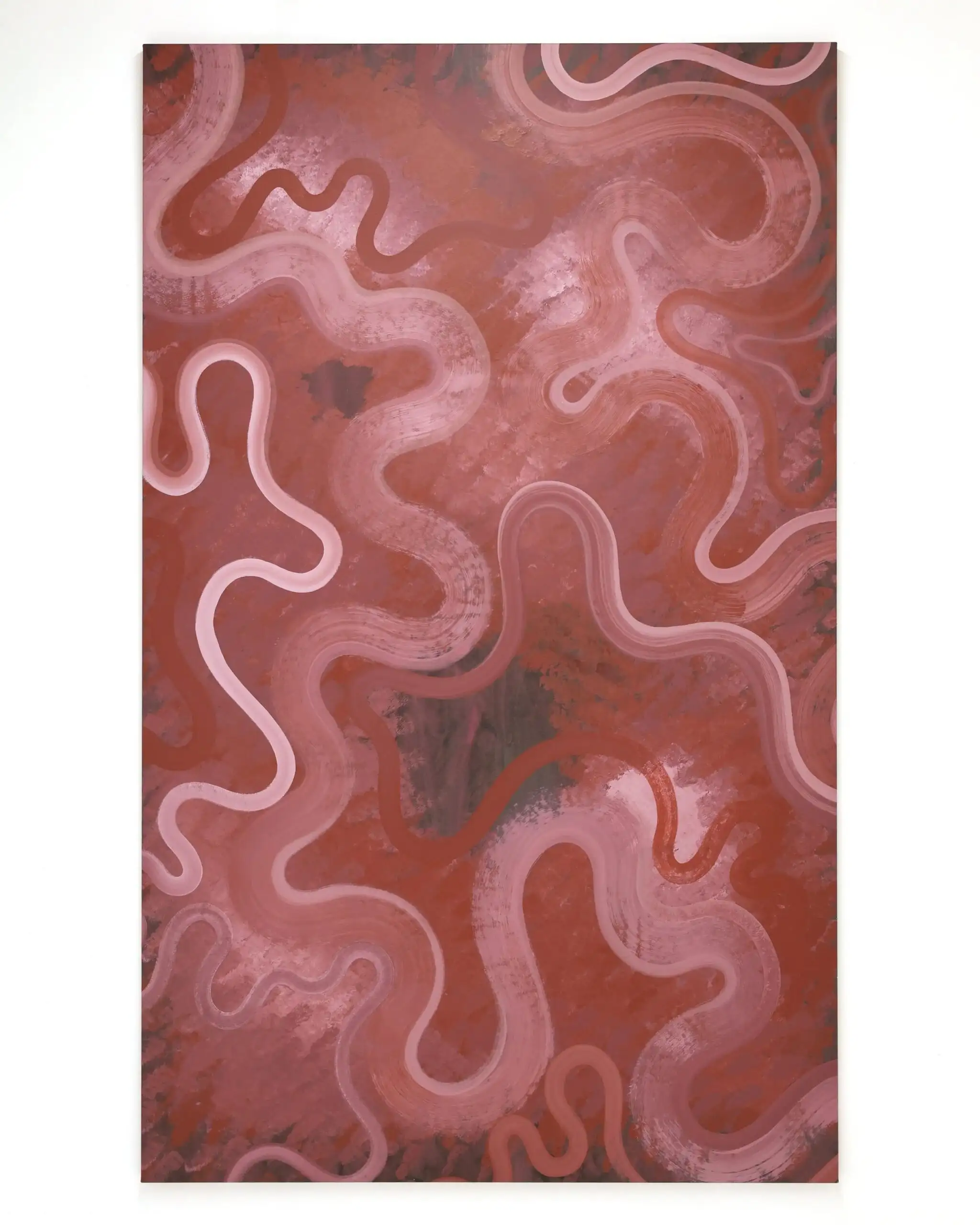
Shaun Daniel Allen (Shal), ‘Between Lands – XL2’, 2025. Synthetic polymer on canvas, 260cm x 160cm.