
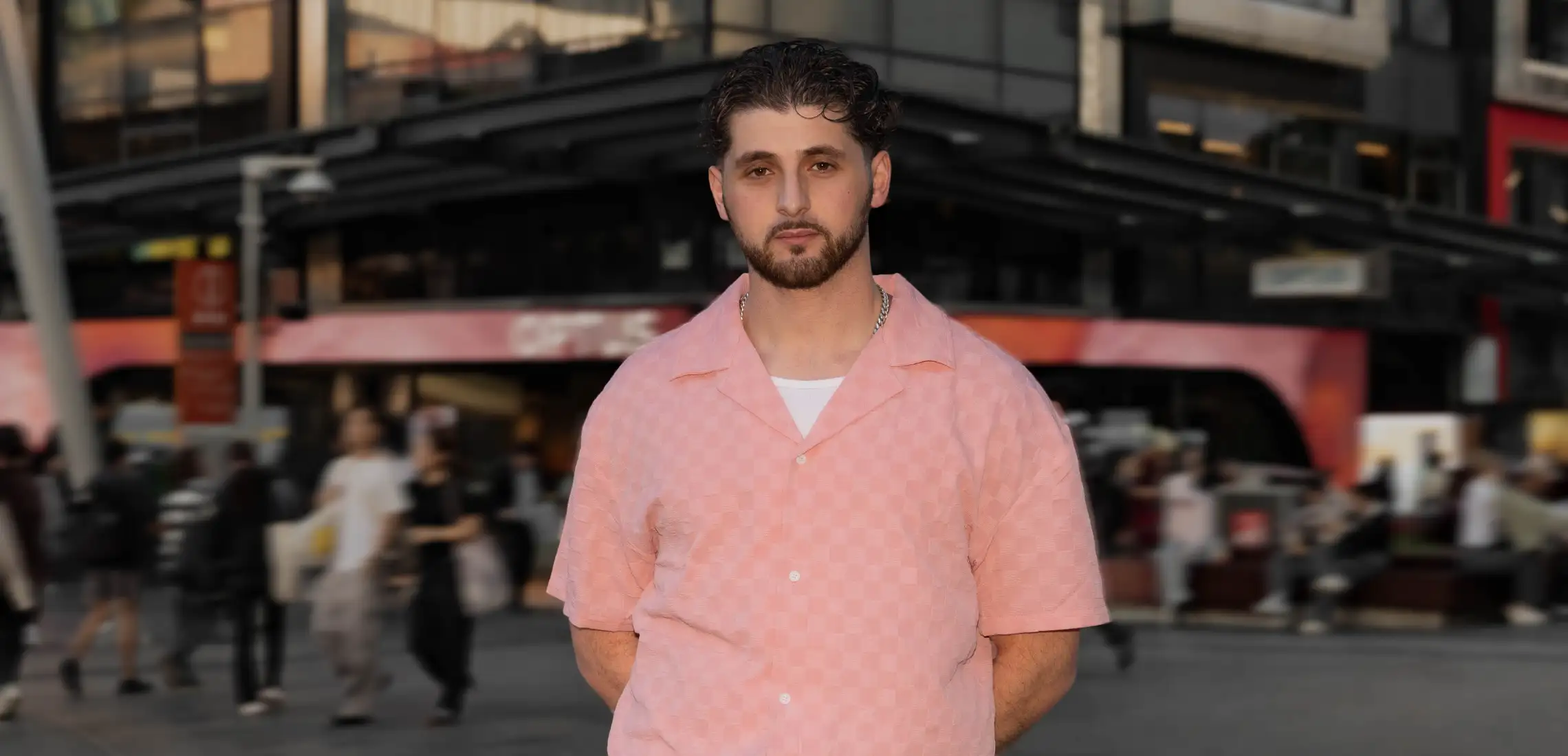
More Than A Haircut: The Barber Dedicating His Time To Helping Others
care beyond the barber’s chair
By Kiri Johnston | 13th September 2026Three years ago, Qendrim Rasiti moved from the UK to Brisbane in search of growth, purpose and a fresh direction. Away from social media, he describes himself as an Albanian Muslim, a devoted son and someone who cares deeply about others. His faith and family sit at the centre of his life, guiding both the future he hopes to build and the way he chooses to spend his time now.
A barber by trade, Qendrim had always been drawn to the transformation that could happen in the chair. It wasn’t simply about a new cut, but the subtle shift that followed when someone looked in the mirror and carried themselves a little differently. “I fell in love with the art of transformation,” he says. “Long before the streets, I was captivated by that quiet magic in the chair — that split second when someone looks in the mirror, sees their light restored, and falls back in love with who they are.”
After arriving in Australia, Qendrim began questioning whether his skills could serve a greater purpose. The answer came during an ordinary walk past a Brisbane park.
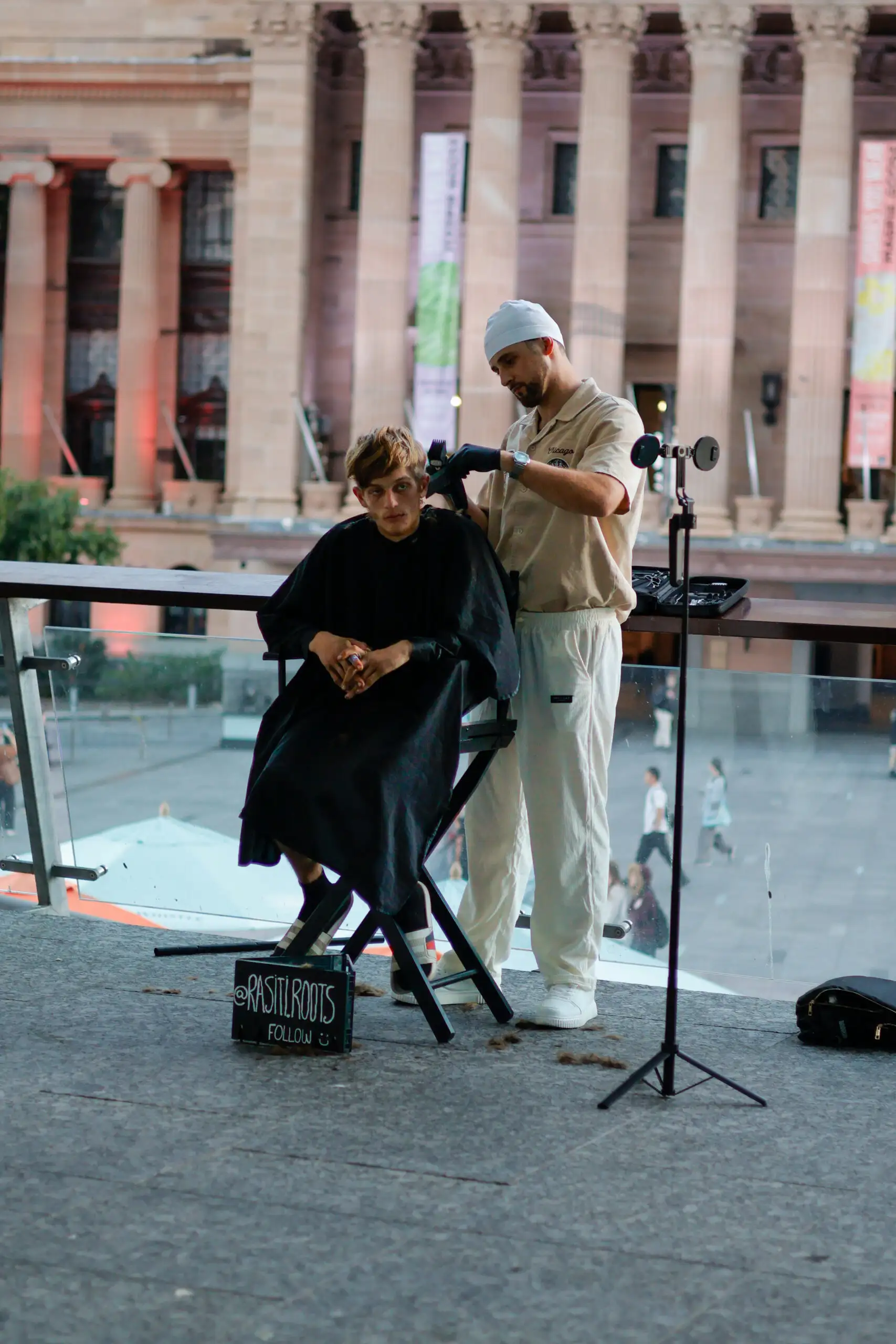
Qendrim Rasiti providing a free haircut in Brisbane. Photography by @adamblackbne.
The haircut that started it all
Qendrim noticed a young man sitting alone on a bench. Instead of seeing only his circumstances, he saw someone who deserved to be approached with the same care and respect as anyone else. He walked over and offered him a haircut. “I was nervous but excited,” he recalls. “My mind was focused on pure respect. I prayed that he would feel seen, honoured and loved — not judged or treated like a project, but approached as a brother with equal value and dignity.”
As the young man lifted his head and his demeanour changed, Qendrim felt something shift in himself, too. That encounter became the beginning of RASITI.ROOTS, his initiative providing free haircuts to people experiencing homelessness across Brisbane. Qendrim has never questioned whether he should continue.
“That first moment in the park planted a seed of love that only grows stronger every day,” he says. “When you see a person’s spirit come alive in front of your eyes, there is no turning back.”
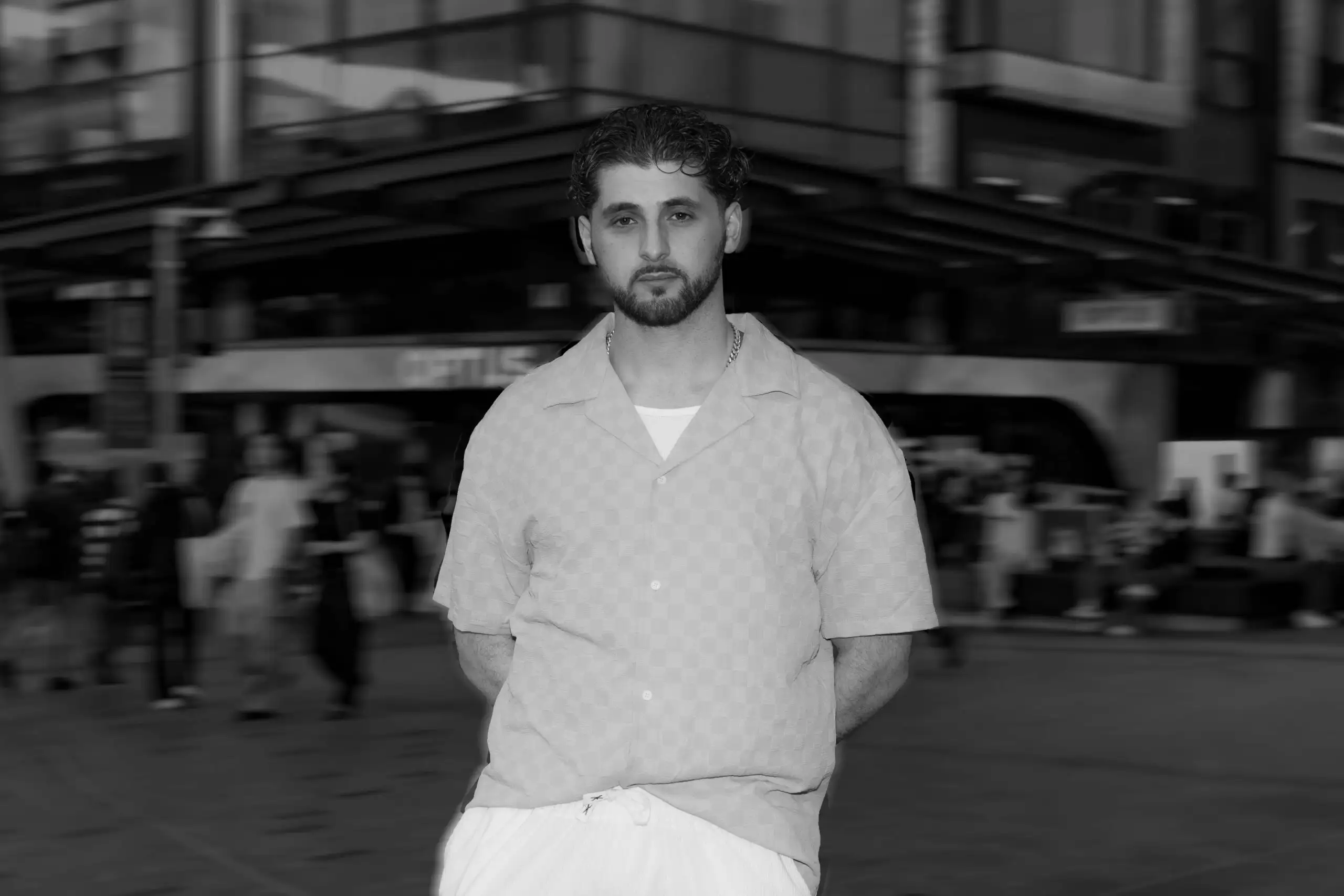
Qendrim Rasiti photographed in Queen Street Mall, Brisbane. Photography by Zoey Thomas of Senncha Studio.
What happens in the chair
What begins with clippers and a chair often becomes something much bigger. There are conversations, stories and moments of recognition that extend well beyond the haircut itself. Qendrim says the change can be visible from the moment someone sits down. “They sit down carrying the weight of the world — shoulders heavy, eyes cast down,” he says. “But as we talk and the transformation happens, their posture lifts and their eyes light up.”
While the physical result may be the most obvious part, Qendrim doesn’t believe the haircut is the most valuable thing he provides. “A haircut is just a tool,” he says. “What I’m really offering is love, dignity, human warmth, and a reminder that they are worthy of a fresh start.”
Through his time on Brisbane’s streets, Qendrim has also confronted many of the assumptions surrounding homelessness. “People on the streets are not invisible, broken or disposable,” he says. “They are living, breathing human beings with deep hearts, beautiful stories and immense potential who have simply fallen on hard times.” Food, shelter and practical support remain critical, but Qendrim believes people also need to feel acknowledged. “They crave human warmth, respect, and to know they still matter.”
When helping becomes content
Millions of people have now watched Qendrim’s videos online. The response has shown him how strongly simple displays of care can resonate, but it has also raised an important question: how do you share someone’s vulnerable moment without turning them into content? For Qendrim, consent is essential. Many of the haircuts happen entirely off camera because that is what the individual prefers. Those people receive the same time and care as anyone who agrees to be filmed. When someone does give their full consent, Qendrim shares their story to challenge judgement and remind viewers of the person behind the circumstances.
“I want people to remember that the person on the pavement is someone’s son, daughter, mother, father, brother, sister, auntie or uncle,” he says. “Any one of us could be in their shoes.” He hopes the videos encourage people to look at homelessness differently — and consider how they respond to the people they encounter in their own communities. “I hope their hearts soften,” he says. “I want them to look at people on the streets with compassion instead of judgement and feel inspired to spread unconditional kindness.” In some cases, the videos have achieved something nobody involved could have anticipated. After recognising family members online, people who had lost contact with loved ones have been able to find them again.
“Once, a daughter reached out to me after seeing one of my videos,” Qendrim says. “She had no idea if her father was dead, alive, in prison, or where he was in the world. Being able to bring them back together and reconnect that family was the best feeling I’ve had in a very long time.” It wasn’t an isolated outcome. Qendrim says his work has now helped reunite several families, making the time he has devoted to RASITI.ROOTS feel invaluable.
The part people don’t see
Behind the uplifting transformations sits a reality rarely captured on screen. Street life can be unpredictable, and listening to people’s experiences comes with an emotional weight. Long after the camera is turned off and the haircut is finished, Qendrim carries many of their stories home with him. “You take home the heartaches, the tears, and the heavy realities of people who feel forgotten,” he says. “It weighs on your soul, but it also fuels your purpose to wake up the next day and keep fighting for them.”
His Islamic faith remains central to how he manages that responsibility. Prayer, time offline and being with his family allow him to step back from the noise of social media and ground himself. The work has also changed how Qendrim measures success in his own life. “Every single soul I meet teaches me profound gratitude,” he says. “They show me that true wealth isn’t in money or status, but in the love we give, the faith we hold, and the way we treat one another when no one is watching.”
Choosing purpose over security
Qendrim has since stepped away from the security of a conventional job to pursue RASITI.ROOTS full-time. The decision meant trading a reliable income for an uncertain path, but he felt he could no longer ignore the importance of the work. “Stepping away from financial security into the unknown was scary, but my soul knew that serving people was my true calling,” he says. “Faith allowed me to trade fear for purpose.”
Hundreds of people now contribute to his work through GoFundMe, allowing him to balance his studies and dedicate more time to providing haircuts. “If I had to work a standard job, I would simply have no time to be out on the streets,” he says. “My supporters are the heartbeat of this movement. By funding this journey, they make it possible for me to devote my days to lifting people up.”
A future beyond barbering
Qendrim’s plans for RASITI.ROOTS reach far beyond free haircuts. His long-term goal is to establish a foundation that can help people secure employment, access safe housing, reunite with their families and rebuild their lives. He also dreams of taking RASITI.ROOTS on the road, travelling down Australia’s east coast to support people and communities affected by homelessness. Within five years, he hopes the initiative will have grown into a global movement capable of helping thousands of people transition away from life on the streets.
For now, however, he wants those following his work to begin somewhere much closer to home. “Start right outside your front door,” he says. “Look for the person who feels invisible in your local community and offer them your time, a meal, or a warm conversation.” It doesn’t have to begin with a grand gesture. “Don’t walk past someone in pain. Look them in the eye, smile, ask them their name, and listen to them with an open heart.” Sometimes, acknowledging someone is where change begins.
Know someone whose story deserves to be told? Contact style’s editor Kiri Johnston at kiri@stylemedia.com.au.
Imagery: photographed by Zoey Thomas at Senncha Studio.