Unpacking Th’ Furniture: The Thinking Behind The Multimodal Art Exhibit At Fountainhead Winehouse Right Now
a stitch in time
By Victoria Lewis | 6th November 2026If you’re in Brisbane right now, there’s an art exhibit that you really ought to pay a visit to. Adorning the walls, floors, and tables of Fountainhead Winehouse until November 12 is George Oliver Studios’ debut exhibition, titled Unpacking Th’ Furniture (and no, the apostrophe is not a typo).
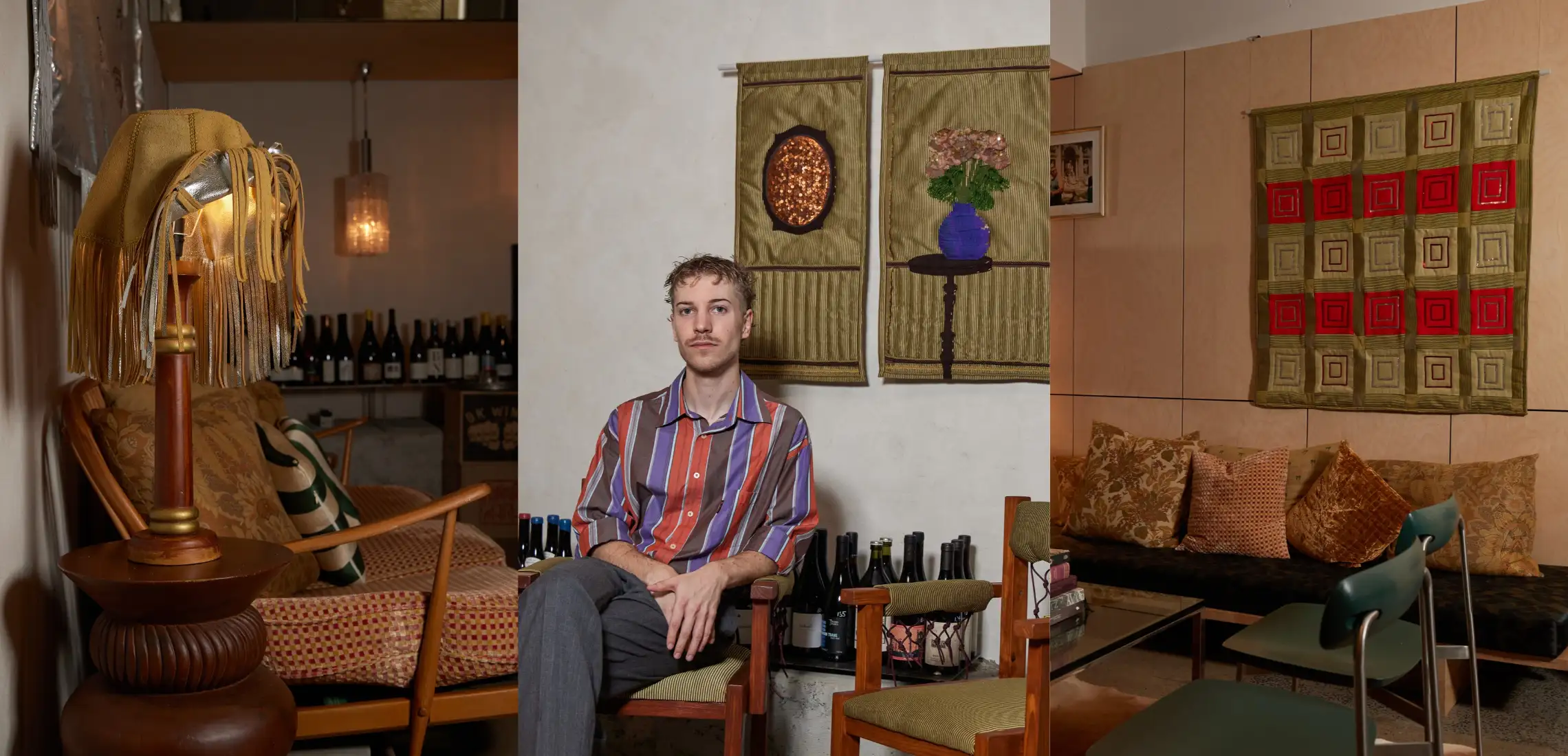
Inspired by the intrinsic thinking that followed George’s recent ADHD diagnosis, the multimodal exhibition takes George’s design background and tests the bounds of sewing as a medium, applying it to furniture, lighting, and quilted textile art.
We chat to artist George about Unpacking Th’ Furniture to get the so-called “convoluted story” of the exhibit.
What’s the thinking behind the name, Unpacking Th’ Furniture?
Unpacking Th’ Furniture is really just the idea of, you know, looking inward at oneself.
Looking at, say, the furniture of your mind: these habits and pieces and scenarios that sit over and over. They’re almost like institutions in there, and you don’t know exactly where they came from, but they form your identity. It’s trying to see where these things come from, and see if they were actually intended for you. If they align with your personality or not, and if they align with the energy that you want to put out into the world.
A funny side note on the ‘T-H’: I was making a sequin sign [because] whenever I do a poster, I love to make it by hand.
I sewed “unpacking” first, and then I did “furniture” second. And I went to do the to do the “the”, and I’m like, “Shit, I’ve run out.” But then I was thinking about America: when they first started doing printing presses, instead of in the UK where they would charge by paragraph, they’d charge by letter in the States. So I like that it’s almost that intuition of just letting things go, but it’s also like half laziness.
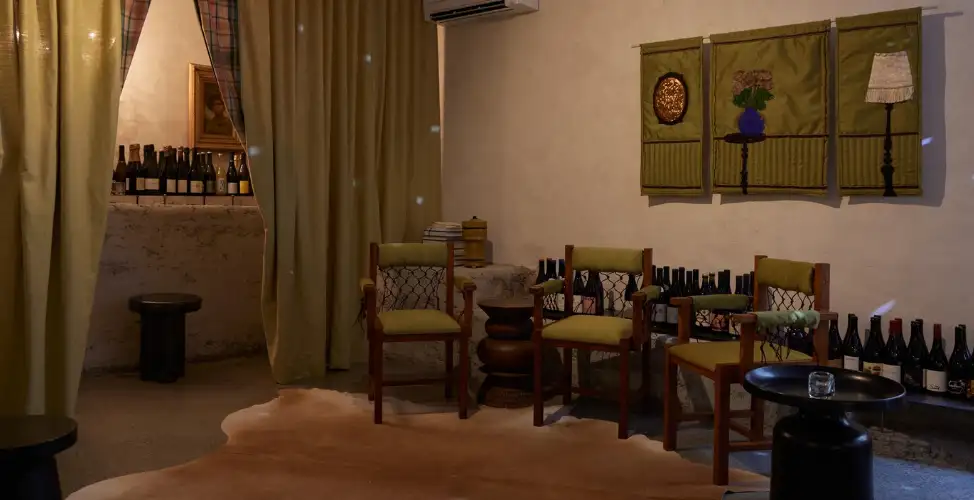
‘Sipper’s Chairs’ and ‘The Hallway’
Why do you work with so many different mediums, like upholstery, furniture, and textile art?
I say that I don’t like to be pigeonholed, but I think that there are so many transferable skills in sewing, and people kind of think that clothing is the only avenue to explore sewing in. We’re kind of conditioned in that way, I think.
I started freelancing kind of out of nothing. I got made redundant and then was just like, “Shit, shit, shit. What do I do?” to make money. So a lot of my earlier jobs were very random things, making belts or wallets or alterations, that kind of thing.
So you, you build those transferable skills regardless. But I also think, you know, there are just so many untapped combinations of things that can be hand-sewn together, and there’s so much uncharted territory. And this is kind of my contribution to the ecosystem of, “Well, this is what I’m thinking,” and if people respond to it and they are inspired by that and it makes them think, “Well, I could be putting this with this,” [it shows that] you don’t necessarily have to present it as this refined, perfect, repeatable object, made for consumption.
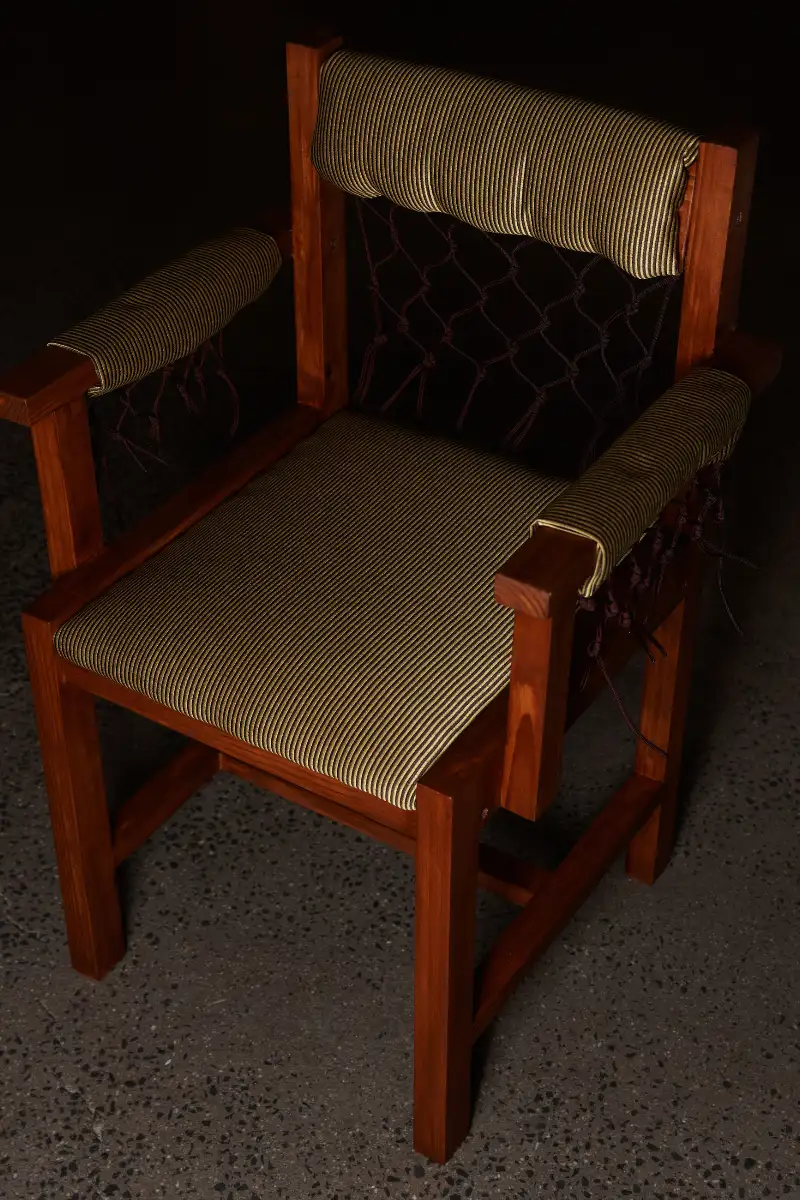
‘Sipper’s Chair’
How did you source materials for your exhibit?
I am such a magpie, in the sense that, you see a little glint even while you’re walking, you’re like, “Ooh, what’s that?” My attention is caught, I think, by these beautiful things. And so many of the [materials], you’re finding them, and they’ve been sitting in someone’s basement or the back of an op shop for 15 years. And I think combining this with other materials that I kind of deem as equal or greater value, it’s kind of to tell other people and set the precedent that materials don’t have to be manufactured.
I could say this on and on, but we have enough.
When I started doing, like, interior commercial textiles, people would say to me that the standard [is] if you need 100 meters of fabric for a project, you should buy 130. So, the estimated wastage is 30%, which is just kind of insane as a precedent, you know? And nobody’s pushing that. So a lot of the materials from this exhibition are leftovers from past interior projects.
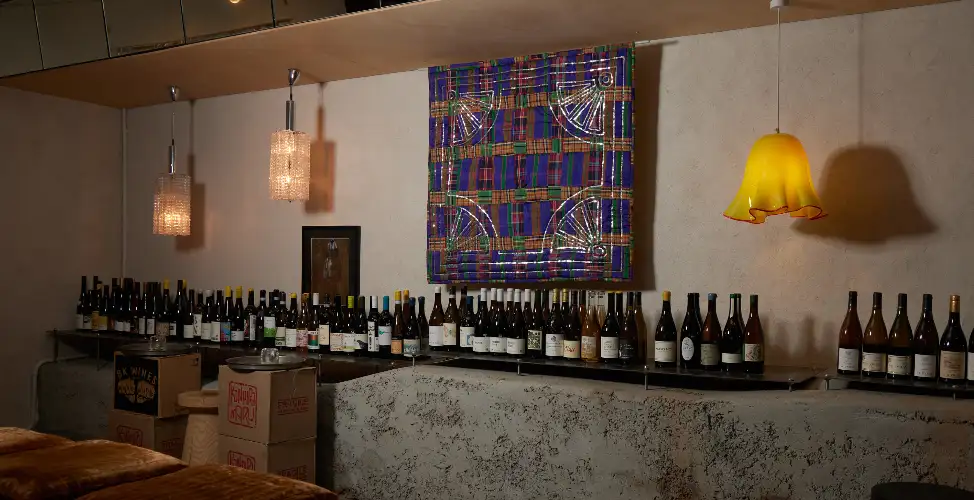
‘Windbreaker’
What was the most time-consuming piece?
The most time-consuming was the large silver quilt. I did a contract at QUT where I was a technician for, like, three months. I met so many awesome students who actually encouraged me when I was kind of first starting freelancing. I kept in touch, and we now help each other with projects sometimes, and I got a bunch of them to come in, and they’ve each done one of these ambiguous figures on the quilt. Then, after they’d finished, I went in and did all of the diamond beading on the background, which was, like, 16 hours of hand beading.
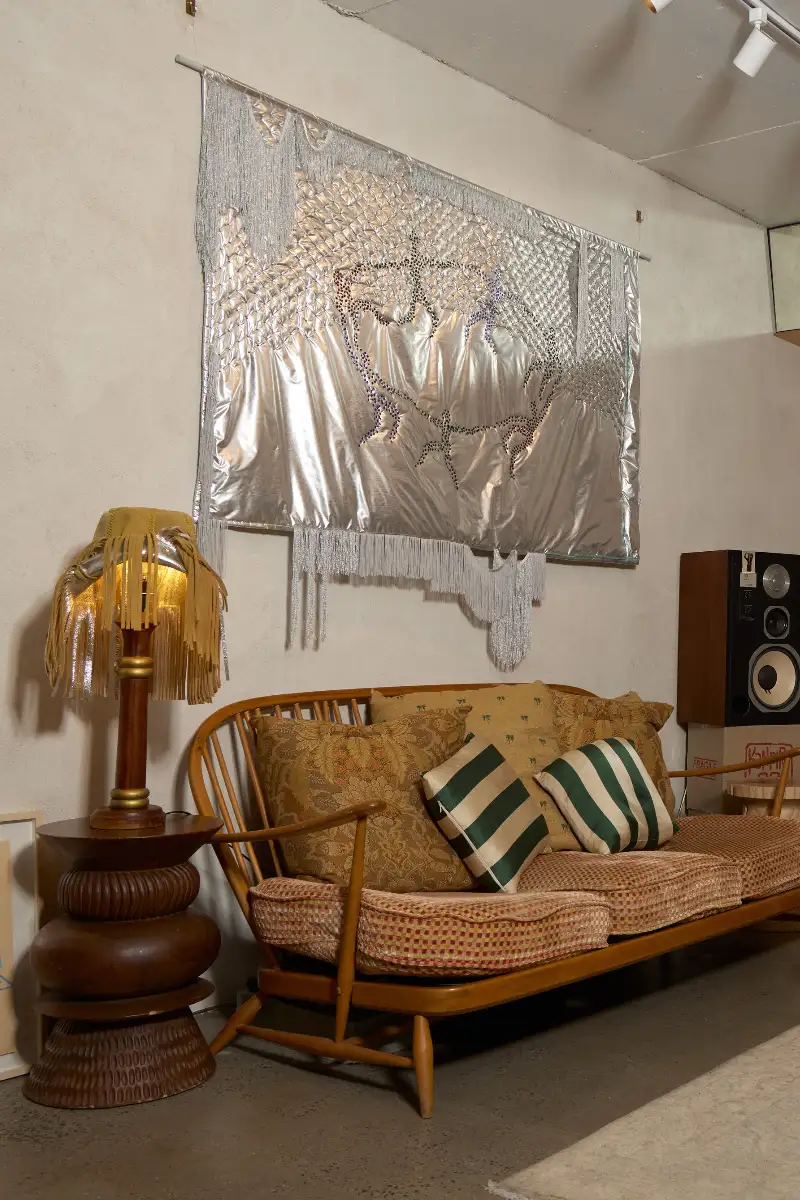
‘Groove’
Do you have any favorites in the collection or any that are the most meaningful?
I actually quite like the one that’s red and green, five-by-five squares, and there are two rows of red. I think that one. I honestly made that one the fastest, which sounds strange. But it was during that time of the process where you’re kinda just like, “Shit, I’ve gotta get it done.” So intuition really led that, where I didn’t even have time to second-guess my process, and I was just responding to the materials in front of me.
Which is something that I always like to say that I fully do, but you can never really let go 100%. But that felt kind of close.
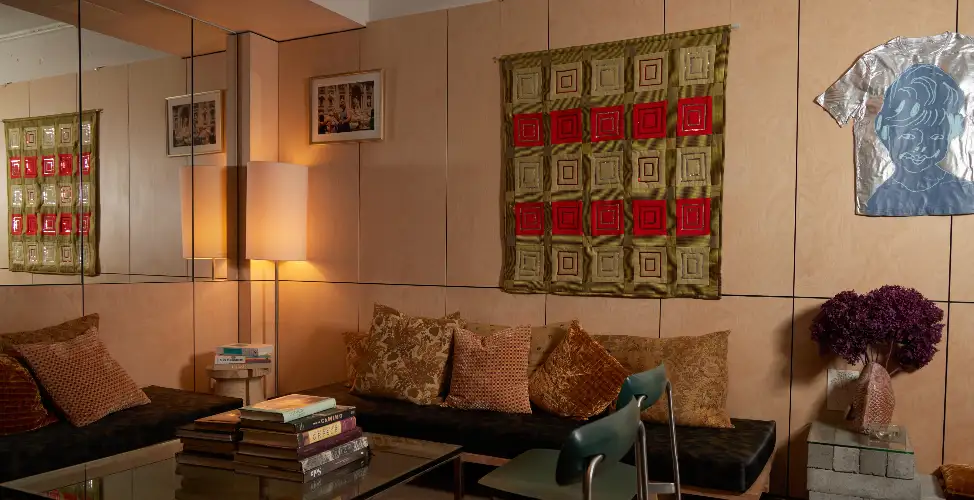
‘Two Rows’
How does it feel to have your first solo exhibition?
It feels really good. It’s been kind of insanely validating.
I feel like with freelancing you’re in uncharted territory, and I feel like I’m kind of challenging a precedent at the same time against the valuing of sewing as labor. So to kind of go through this uncharted territory, make it out the other side, and have people agree that what I’m doing is worthwhile, it’s like, that’s the whole point.
Check out the exhibition in person at Fountainhead Winehouse until 12 November.
Imagery: James Caswell