Inside Brisbane’s State-Of-The-Art Glasshouse Theatre: Australia’s Biggest Performing Arts Centre
Through the looking glass
By Natalie McGowan | 28th April 2026Queensland Performing Arts Centre (QPAC) is Brisbane’s home of live performance – and it just got a state-of-the-art upgrade, making it the largest performing arts centre in Australia, setting the stage for up to 1.6 million annual visitors.
Despite what a certain Oscar-nominated A-lister might say, opera and ballet – along with the performing arts more broadly – are very much alive and well. The proof is in the numbers (“The box office speaks for itself,” says Chief Executive at Queensland Performing Arts Centre, Rachel Healy) and in the recently completed Glasshouse Theatre, now open after eight years and $184 million invested in its build.
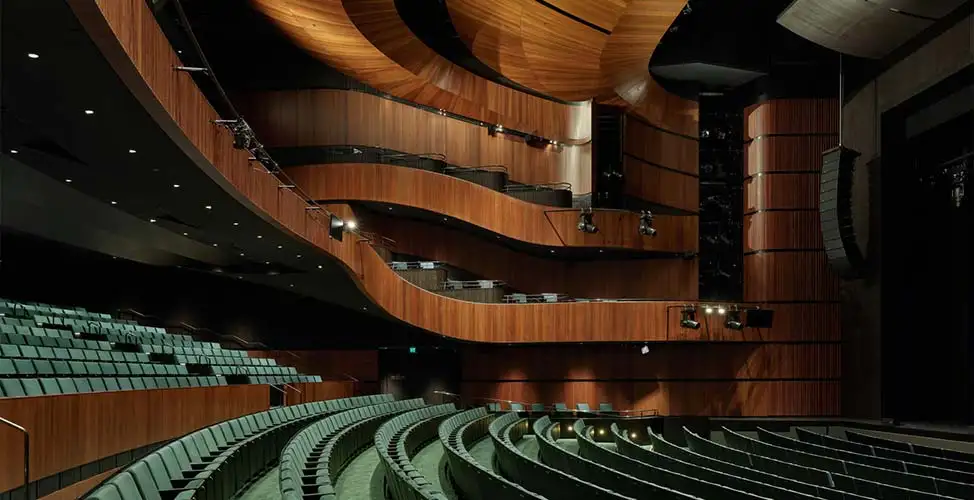
Designed to accommodate art forms spanning opera, ballet, musicals, symphony, and theatre, the Glasshouse Theatre seats up to 1,500 patrons and features world-class technical facilities. Among them is an impressive retractable orchestra pit, capable of accommodating bands of all sizes, from eight to 80. “Famously, you could never do Wagner’s Ring Cycle at Sydney Opera House, because the pit is just too small to accommodate the number of musicians that the score needs,” says Rachel Healy. “At the Glasshouse, we can simply expand the pit by taking out up to five rows of seats for the musicians to slide in underneath.”
The theatre is the culmination of the QPAC team’s collective experience, drawing on decades of work locally, nationally, and globally, distilled into an architect’s brief aimed at delivering an outstanding performance space that can rival the world’s best theatres. One key insight was the importance of capturing the feeling of intimacy, which was achieved by implementing wraparound balconies that extend close to the stage, with the furthest seat from the stage just 28 metres away. Here, even the “nosebleeds” feel like prime real estate; there isn’t a bad seat in the house.
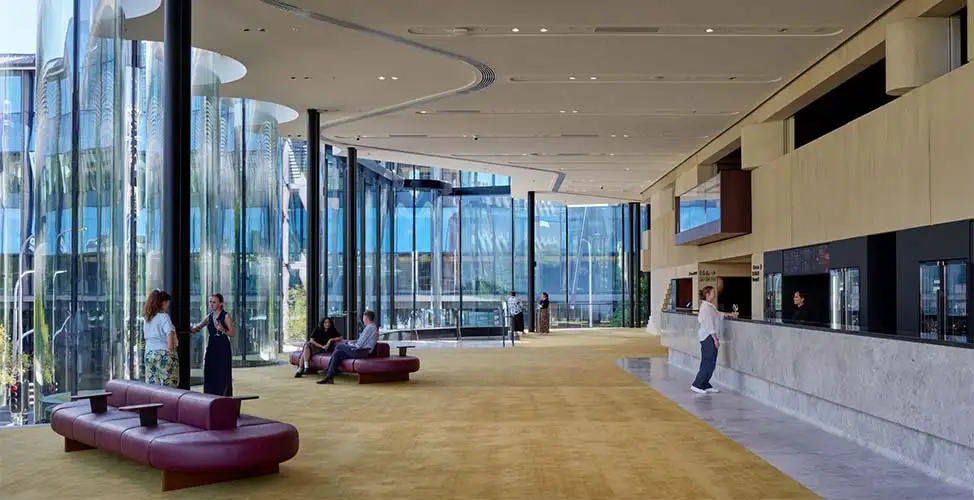
The Glasshouse Theatre marks an important cultural milestone for Brisbane, showcasing a city with a sustained appetite for the arts. “We are known to big commercial promoters like Disney and Crossroads Live as the strongest market in the country,” says Rachel. “Our audiences come from all over Queensland and, increasingly, interstate. Live performance here is not for the elite; it’s for everyday, ordinary Queenslanders. The look of the foyer when people start to arrive, it looks like people have walked across from Queen Street Mall. The look of that foyer tells you how integrated live performance really is in our community.”
On the opening programme at the Glasshouse Theatre, Rachel cites The Last Ship as an example of the kind of heavy hitters QPAC can host while continuing to champion more local stories. The acclaimed musical, for which Sting wrote the music and also performs and acts, alongside recently added cast member Shaggy, allows audiences to get up close and personal with some of the world’s biggest stars. “You should not have to get on a plane to see the great global artists of our time,” says Rachel. Together with Queensland Ballet’s Messa da Requiem and Leah Purcell’s The Drover’s Wife opera, it’s a strong lineup that showcases exactly what the Glasshouse Theatre can do.
Architecturally speaking, the Glasshouse Theatre is quite the feat. In May 2018, Blight Rayner – a Brisbane-based firm behind projects including Kangaroo Point Bridge and Jubilee Place – alongside the Norwegian-founded Snøhetta, won the international design competition for the Queensland New Performance Venue (NPAV). The brief insisted the theatre needed to be like a “finely tuned instrument.”
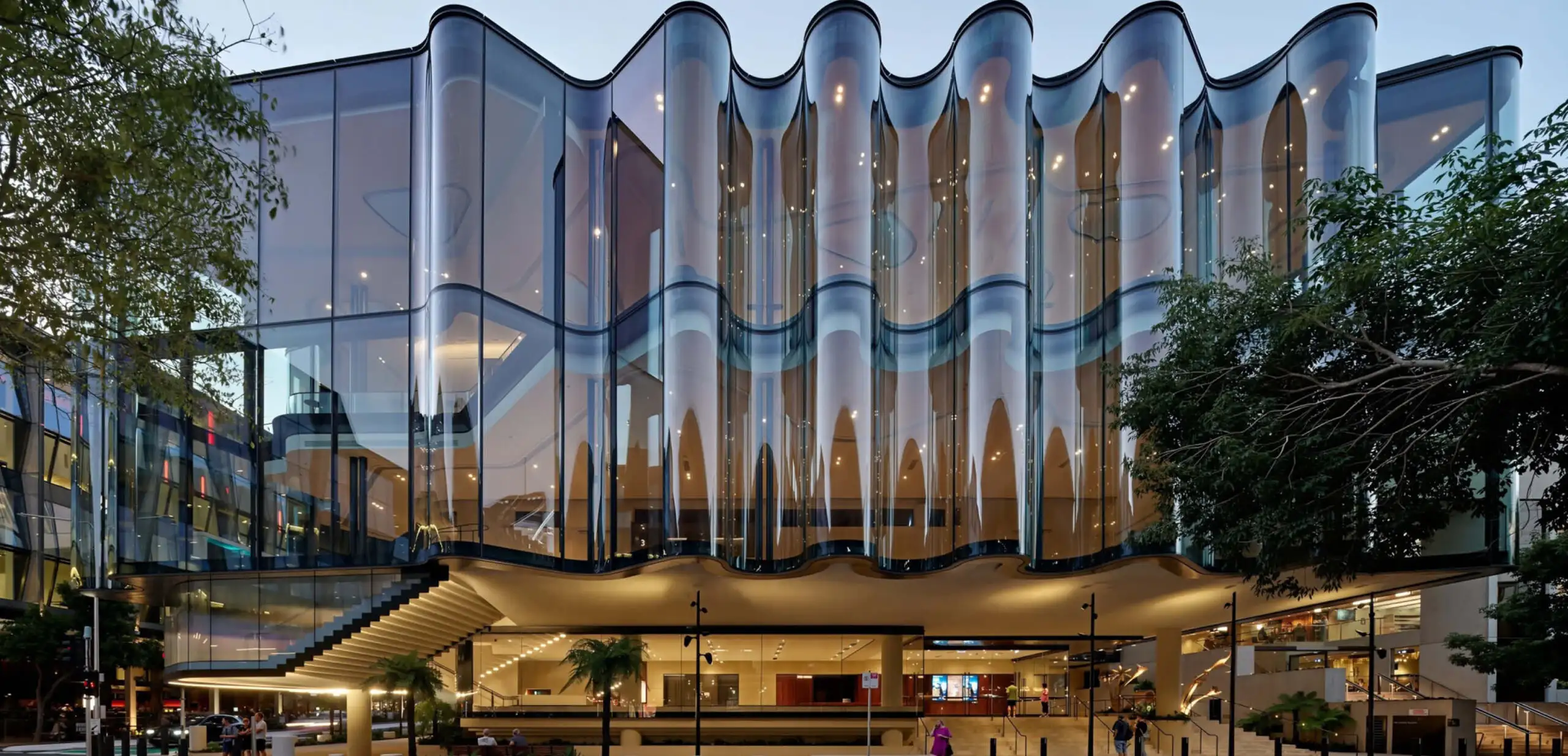
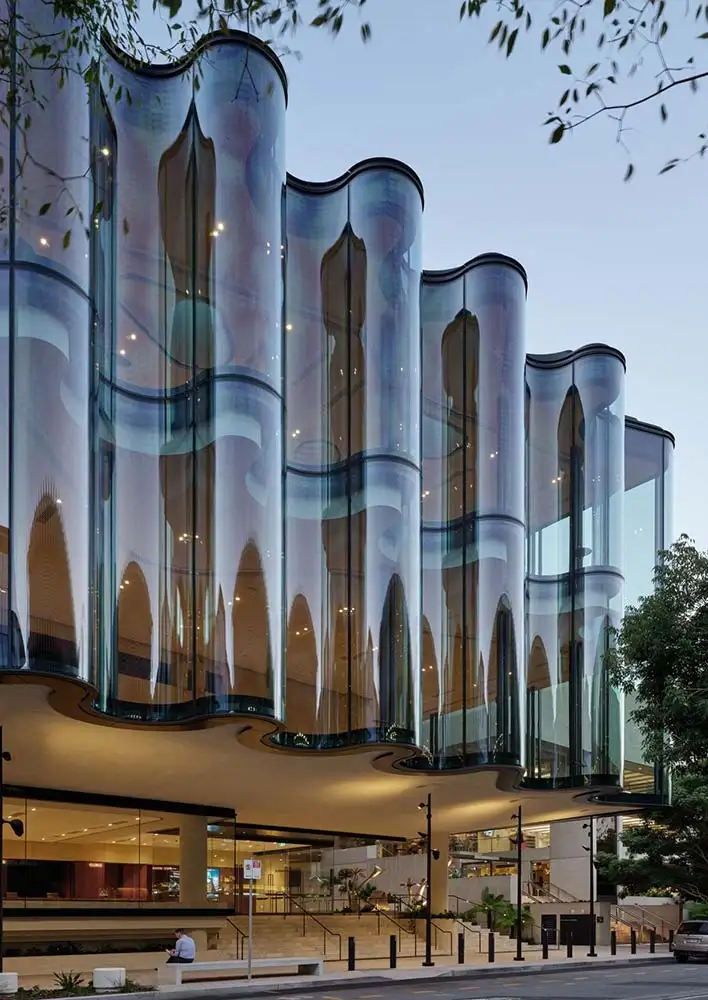
At 14 metres high and 173 metres long, the rippling glass façade was designed to make the theatre feel accessible to all, even passersby. Director at Blight Rayner, Michael Rayner, says the intention was for the public to feel as though they were watching a performance from the street. “The glass gives clear and blurred definition to the people as they move through the foyers inside, conveying a sense of the magic and mystique of theatre,” he says. “This becomes more evident by night, the people seemingly performing in an impromptu play.”
The façade comprises 217 glass panes spanning more than 2,300 square metres, with the largest panel weighing roughly 2.4 tonnes. These were manufactured by Austrian company Seele, the same company behind Apple’s Fifth Avenue Store in New York and the interior LED screen wall at Las Vegas’ Sphere.
The concept for the façade draws from Kurilpa Country, a poem by Aboriginal artist and Elder Lilla Watson, with its undulating form echoing the ripples of the Brisbane River. “The idea was to abstract this image where people inside seen from the street would variously be seen clear and blurred, like the fish through rippled water,” says Michael.
Seven skylights further acknowledge First Nations stories, representing Queensland’s seven watersheds, informed by research from Elder-in-Residence at QPAC, Colleen Wall. This is complemented by a sculpture by Torres Strait Islander artist Brian Robinson, referencing native flora and its cultural significance.
By embedding Aboriginal and Torres Strait Islander narratives so deeply into the bones of a place built for storytelling, the Glasshouse Theatre symbolises something greater than a venue where stories are told; it’s a story in itself – and one that raises the bar for Queensland’s performing arts scene.