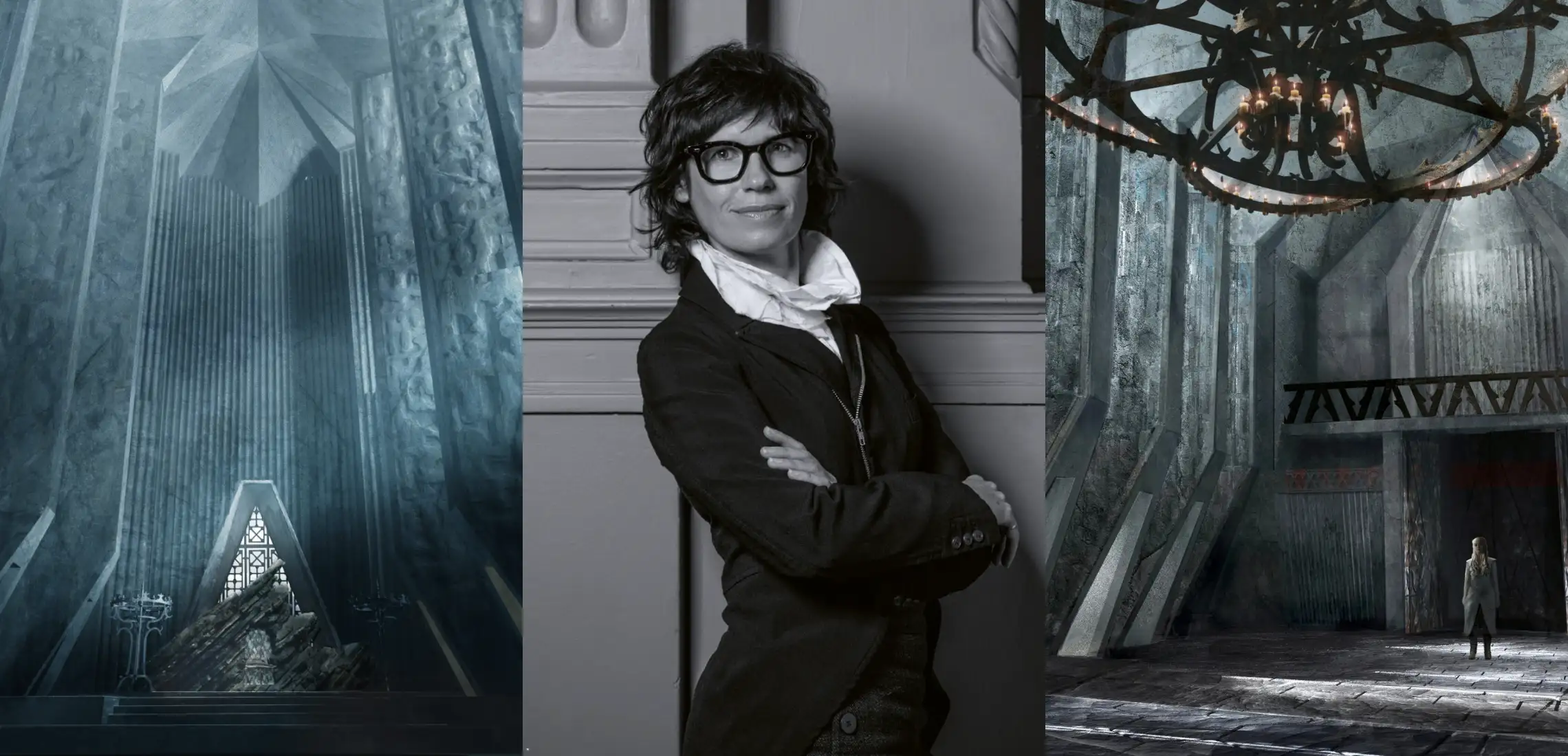
Meet The Brisbane Woman Who Became The Set Designer Behind Game Of Thrones & The Matrix
world builder
By Natalie McGowan | 2nd July 2026One merely needs to glance at Deborah Riley’s IMDB credits to deem that she is an awfully impressive woman – one who has most likely worked on at least one film or TV show you’ve seen.
When Deborah Riley took over as production designer on Game of Thrones during the show’s fourth season in 2013, it was a monumental undertaking that saw her up and leave for Belfast, consistently work six-and-a-half-day weeks, lead a hundreds-strong arts department across multiple countries and time zones, and convince millions of people around the world that the fictional continent of Westeros could conceivably exist somewhere in the world. After all, the more they believed in the world, the more they would believe in the dragons.
“I had to view the world of Westeros like it was a documentary, in a way,” says Deborah. “I thought about the old Hong Kong airport, where the planes would come in between the skyscrapers and you could look out the window and see somebody doing their laundry – and equally, somebody doing their laundry could see a big jet flying past. I always thought of the dragons like that, like they just had to exist in our world.”
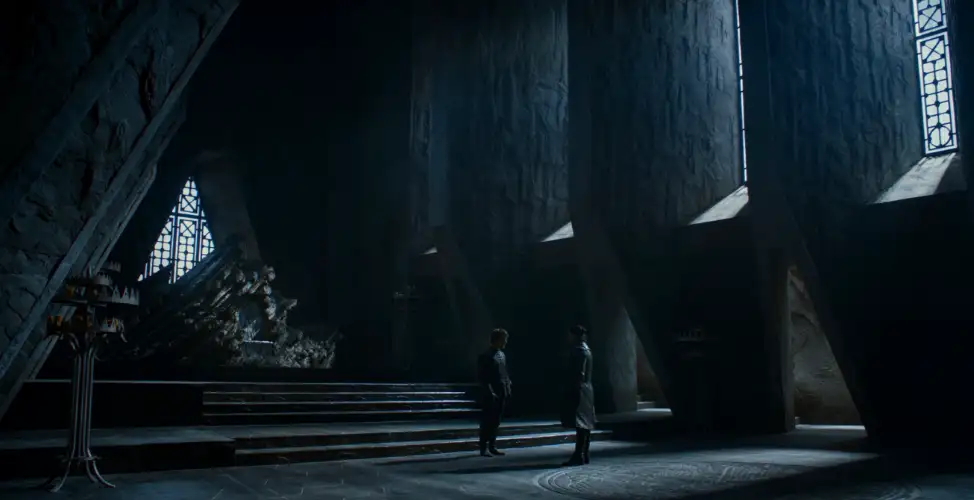
Image: Dragonstone Audience Chamber (Helen Sloan for HBO)
After wrapping her first season, she won a Primetime Emmy Award for Outstanding Art Direction for a Contemporary or Fantasy Series. Born and raised in Brisbane, Deborah was certain at eight years old she wanted to be a cartoonist. Later, she would consider becoming an animator. She went on to study architecture at the University of Queensland (UQ), fully intending to become an architect, until a trip to the cinema changed everything. It was watching Tim Burton’s Batman Returns after graduating that she first considered set design as a career possibility, let alone what she would spend the rest of her life doing. After leaving the cinema, she felt so inspired she returned to her old high school to flick through the career guides, researching everything she could about the industry (“There was no such thing as the internet back then!”).
Shortly after, she relocated to Sydney to attend the National Institute of Dramatic Art (NIDA), studying stage design. By the late ‘90s, Deborah had graduated from NIDA and was working odd jobs drafting operas. It was around the time that the American film industry was showing a growing interest in Australia as a filming location, though the local crews weren’t as large as what productions could get in the United States. So, when the art department for a film shooting in Sydney needed more hands, Deborah interviewed for the role – only she wasn’t entirely sure what she was interviewing for. “I’ll never forget, on the day I was interviewed, they took me down to the massive workshop they had in Mascot where they had a giant fibreglass helicopter hanging from the rafters,” she says. “I thought, ‘Wow, what is this place?’ and the art director showing me around said, ‘It’s a feature film, Deb,’ and that was it. I was sold.” She landed the job as a set designer. The film was The Matrix.
Deborah would go on to work on a number of high-profile projects, including Anna and The King, 21 Grams, and as art director for the Sydney 2000 Olympic Games closing ceremony. But it was her work on Moulin Rouge! in 2001 that she considers the most foundational moment of her career.
Working closely with fellow NIDA graduates Baz Luhrmann and Catherine Martin as assistant art director – helping to design and erect the iconic, ornate elephant that Satine, played by Nicole Kidman, resided in – she warmly remembers their rigour.
“They had such an extraordinary amount of dedication to the craft, and I found that so inspiring.”
Coincidentally, a few days after my conversation with Deborah, Baz Luhrmann was also reflecting on that time, posting to Instagram with the caption: “25 years ago, Catherine and I had a young design assistant named Deborah Riley – she went on to design the sets for Game of Thrones! We’re always incredibly thrilled when young juniors of ours flourish beyond our work.”
It was these formative experiences that would lead her to land the role on Game of Thrones, for which she would go on to win three more Emmys by the show’s conclusion in 2019. On that period of her life, she recalls the boundless hard work of the crew, the long days that stretched well into the night, and so much travel between countries due to the scale of production filming concurrently around the world that at the end of one season, she had accumulated around 60 boarding passes.
She also recalls it being the time of her life. “There was a lot of adrenaline coursing through my veins. I didn’t really think about it, I was too busy having a great time. That was the thing about Game of Thrones: we all knew it was the best job any of us were ever going to have, so we didn’t dare complain.”
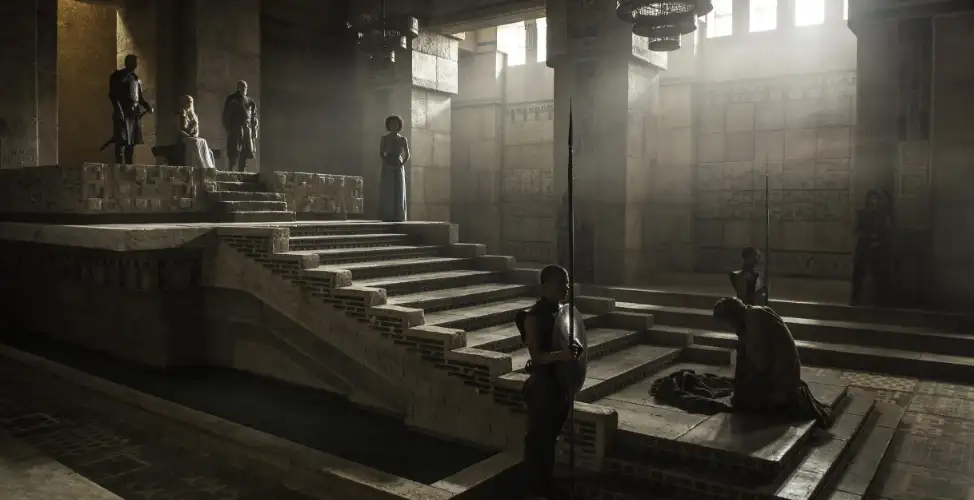
Mereen Audience Chamber(Helen Sloan for HBO)
Beyond Game of Thrones, she reunited with the same team to work as production designer on 3 Body Problem – a science fiction series that brought new challenges but the same fundamental task: making an entirely new world believable to the viewer. For this, Deborah says she had to approach the show as “science fact”. She also recently wrapped on Greyhound 2, a World War II film shot in Sydney, for which she and the arts crew had just 12 weeks to build a 73-metre long, 14-metre wide exact replica of a US Naval Destroyer. It was a race against time, but when it was all said and done, the pride in what they had built was immense, made all the more meaningful when the film’s stars, Tom Hanks and Stephen Graham, were captivated by what they saw. “It was such a compliment. There’s some wonderful footage of Stephen and I walking around the set and he was absolutely mesmerised, tapping everything with his hands, going ‘I can’t believe this is made from plywood.’”
Looking back on it all, she views her career as a series of course corrections, from the little girl in Brisbane who wanted to be a cartoonist, to leaving NIDA certain she would work in theatre, to the woman I’m speaking with today: an Emmy Award-winning production designer working on some of the world’s biggest sets.
“I know I found my home,” she says.
Imagery: Dragonstone Audience Chamber (Helen Sloan for HBO) / David Silva / Dragonstone Audience Chamber 2