It Was Never Just A Skirt: Unpacking The Politics Of The Pencil Skirt
sex, class & power
By Chloe Welling | 30th October 2026In 2006, Miuccia Prada told journalist Ingrid Sischy, “the skirt is like a t-shirt.”
What she was referring to is the skirt’s ease and open-endedness, the multitude of opportunities it offers both designer and wearer. For the designer, it’s a fixed parameter for expression; for the wearer, choose your own adventure.
Paired with a collared shirt and knee-length hem, a skirt is office-ready. Add a leather bomber jacket and combat boots, and it takes on a punkish edge. The skirt, in essence, is engineered for freedom.
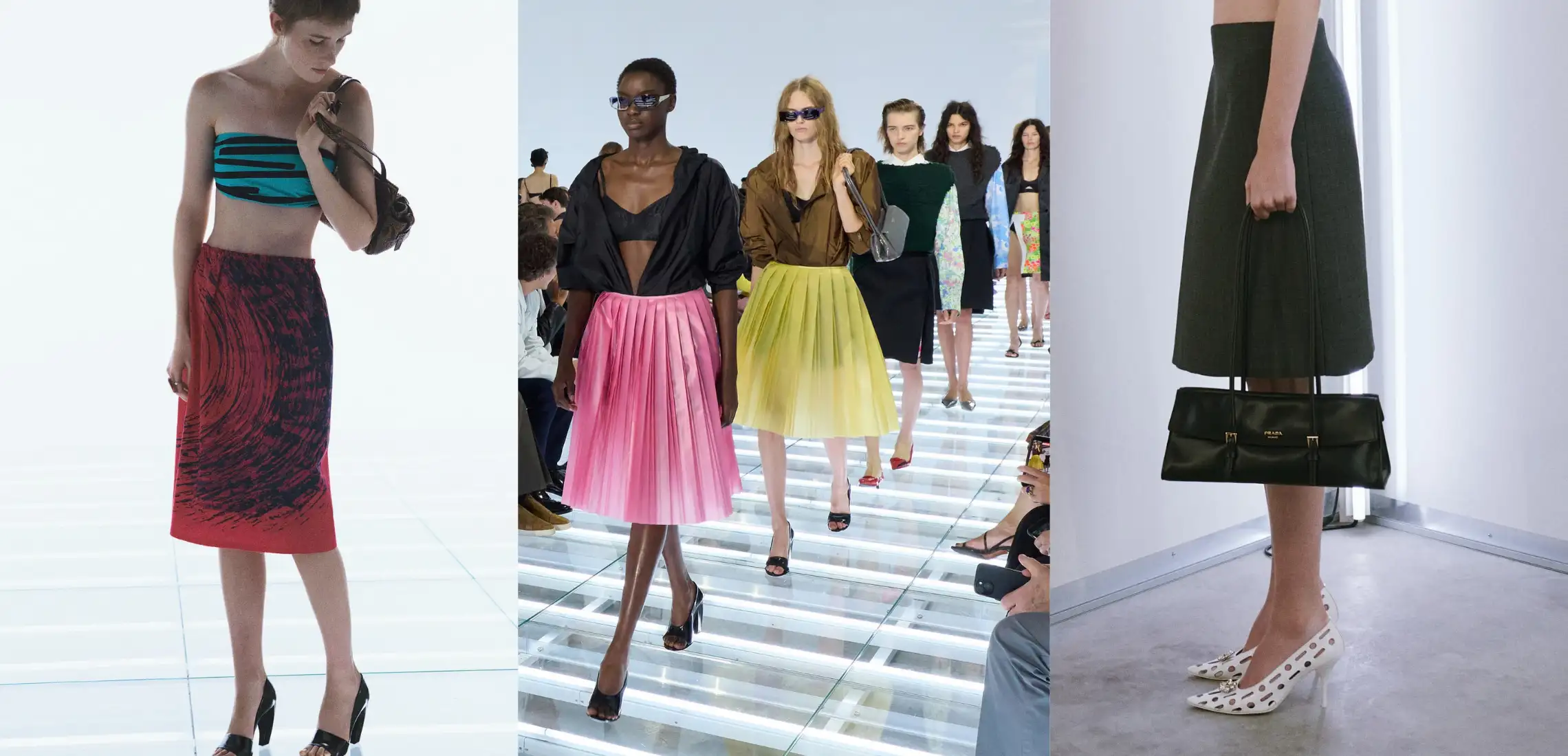
Nearly two decades later, Mrs Prada and co-creative director Raf Simons returned to the universal garment for Prada’s spring/summer 2027 collection. Together, they offered 63 Prada-fied takes on the skirt, from a crystal-embroidered Velcro wrap to a slip encased in crinoline.
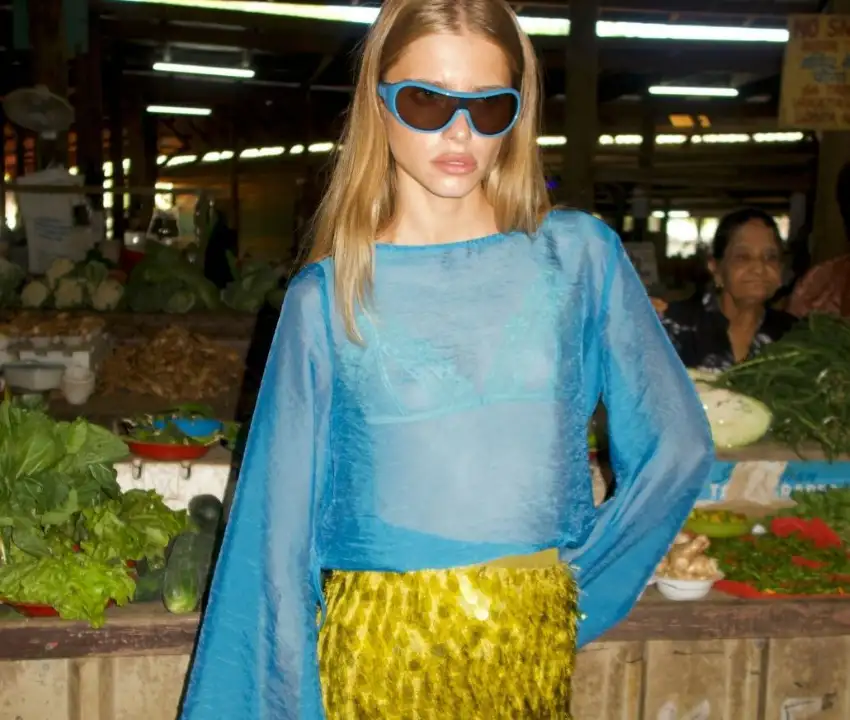
Beyond Prada, skirts were ubiquitous this season. At Eckhaus Latta, they came in rumpled metallic fuchsia; at Valentino, in embellished mousseline edged with plum feathers; at Christopher Esber, in swathes of lace ribbon. The variations were as flamboyant as they were far-reaching, yet one silhouette proved inescapable: the pencil skirt.
Few garments carry as much emotional baggage as the humble pencil skirt. Entangled with shifting ideas of femininity, eroticism, power, and propriety, it is a canvas onto which society projects clichés of feminine role play.
Physically, the pencil skirt is an exercise in constraint. Its narrow cut shortens the stride, reducing the wearer to small, staccato steps and limiting forward momentum. Yet symbolically, it promises power. It conjures the powerful woman in the boardroom while summoning fantasies of the submissive secretary. It evokes themes of the sexually assertive dominatrix, while its modest hemline signals propriety.
Ultimately, the pencil skirt is both an instrument of restraint and an emblem of agency. A piece that offers the appearance of power while prescribing the terms on which it may be wielded.
Fashion trends are rarely arbitrary. They respond to shifts in the cultural tectonic plates, with many designers proposing silhouettes that grapple with the present while imagining what may equip us for the future.
All of which is to say, fashion reflects the world around us.
In this context, Prada’s vision for the skirt is persuasive. By reinterpreting a familiar garment while leaving room for the wearer’s identity, Mrs Prada and Simons make a case for individuality in an era increasingly shaped by social media’s homogenising force.
It’s a proposition that feels particularly relevant to the pencil skirt, a silhouette burdened by assumptions about power, sexuality and conventionalism. Yet, as Mrs Prada and Simons suggest, a garment’s meaning is never fixed, it shifts through its friction and through the agency of the person wearing it.
The pencil skirt’s ubiquity this season, alongside Prada’s proposition, serves as a reminder that no skirt belongs to any one woman, nor does it have to mean one thing. In Prada’s eye, the pencil skirt is merely another blank canvas, one whose meaning is finally in the hands of the beholder.
Imagery: @prada